CNC Machining Processes and Comparison
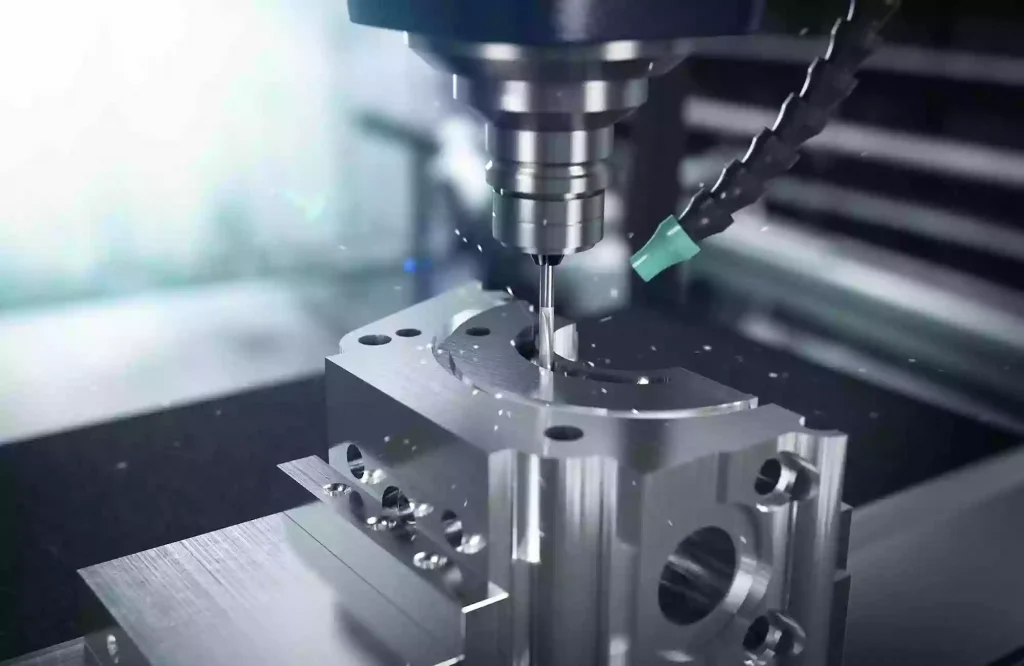
CNC machining has become one of the most widely used manufacturing methods for producing precision parts across various industries. By removing material from a workpiece using computer-controlled machine tools, CNC machining enables manufacturers to achieve high precision, complex geometries, and consistent quality from prototype to mass production.
However, CNC machining is not a single process. Different machining methods, including CNC milling, CNC turning, drilling, boring, and five-axis machining, are designed to meet specific part geometries, material requirements, tolerance levels, and production needs. Choosing the appropriate machining process is crucial for balancing accuracy, efficiency, surface quality, and manufacturing costs.
For example, CNC turning is generally more suitable for cylindrical parts, such as shafts and bushings; while CNC milling offers greater flexibility for machining complex features such as grooves, contours, and irregular surfaces. Meanwhile, multi-axis machining and specialized processes are often required when producing parts with tight tolerances or complex geometries.
This guide will explore the major CNC machining processes and compare their performance, advantages, limitations, and applicability. By understanding the differences between each approach, engineers and manufacturers can make better decisions when choosing the most effective CNC machining solution for their projects.
Overview of Common CNC Machining Processes
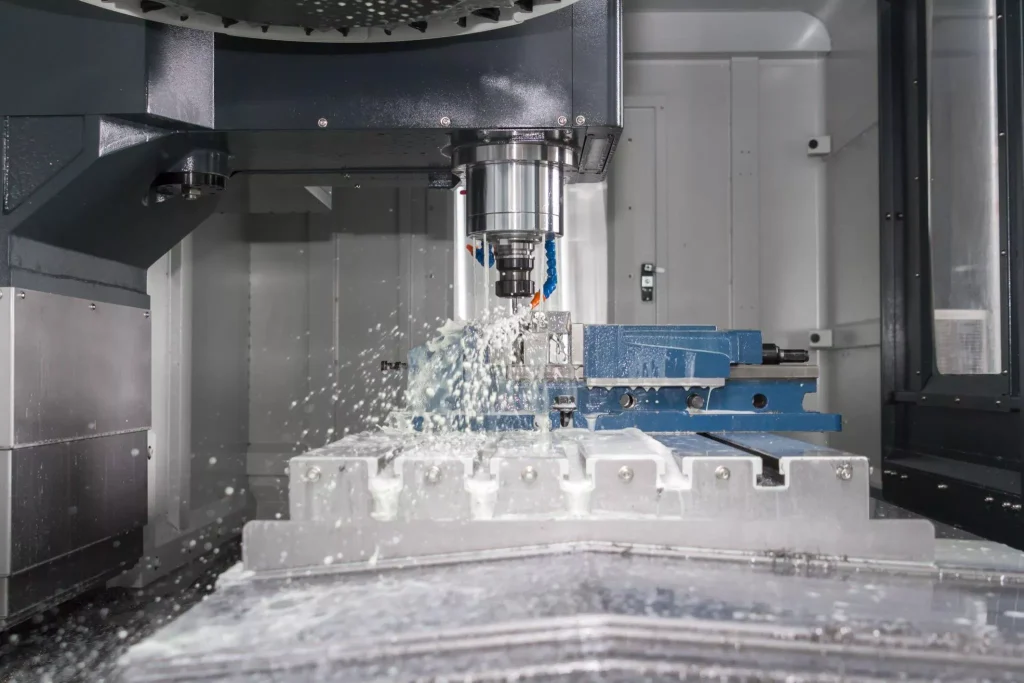
CNC machining encompasses a variety of manufacturing methods, each designed for specific machining requirements. Although these processes all rely on computer-controlled motion, their cutting principles, capabilities, and applications vary considerably.
Understanding the characteristics of each CNC machining process helps engineers select the most suitable machining method based on part geometry, tolerance requirements, surface finish, material properties, and production volume.
CNC Milling
Working Principle
CNC milling is one of the most widely used machining processes for producing precision components. It uses rotating multi-point cutting tools to remove material from a stationary workpiece. During machining, the cutting tool moves along programmed axes to create different features, including flat surfaces, pockets, slots, holes, and complex contours.
Depending on the part complexity and production requirements, CNC milling can be performed using 3-axis, 4-axis, or 5-axis machining centers. While 3-axis milling is suitable for many standard components, multi-axis machining provides greater flexibility by allowing the tool to approach the workpiece from multiple directions.
Advantages and Limitations
The biggest advantage of CNC milling is its versatility. It can produce both simple and highly complex geometries, making it suitable for prototypes, custom components, and low-to-medium volume production.
CNC milling also provides excellent dimensional accuracy and repeatability when proper machining parameters and tooling are selected. It can process a wide range of materials, including aluminum, stainless steel, titanium, copper, and engineering plastics.
However, CNC milling may require longer setup and programming time for complex parts. In addition, machining hard materials can increase tool wear and reduce cutting efficiency.
Common Applications
CNC milling is commonly used for:
- Mechanical housings and enclosures
- Brackets and fixtures
- Mold components
- Aerospace structural parts
- Medical device components
- Custom precision parts
CNC Turning
Working Principle
CNC turning is a machining process mainly used for manufacturing cylindrical and rotational components. Unlike milling, where the cutting tool rotates, turning removes material by rotating the workpiece against a stationary cutting tool.
During the process, the workpiece is held in the spindle and rotates at a controlled speed. The cutting tool moves along the axial and radial directions to perform operations such as facing, diameter machining, threading, grooving, and boring.
Modern CNC turning centers can also integrate milling, drilling, and tapping operations, allowing multiple features to be completed in a single setup.
Advantages and Limitations
CNC turning offers high machining efficiency for rotational parts. It provides consistent dimensions, good surface finishes, and excellent repeatability, making it suitable for both prototype and production machining.
Compared with milling, turning usually requires simpler setups and is more cost-effective for high-volume production of cylindrical components.
However, CNC turning has limitations when machining irregular shapes or parts with complex non-rotational features. Components with pockets, angled surfaces, or complex contours usually require additional milling operations.
Common Applications
CNC turning is widely used for:
- Shafts and pins
- Bushings and sleeves
- Threaded components
- Hydraulic fittings
- Connectors
- Rotational mechanical parts
CNC Drilling
Working Principle
CNC drilling is a machining process used to create holes in a workpiece using rotating drill tools. It is one of the most common machining operations and is often performed as part of a larger CNC milling or turning process.
During drilling, the cutting tool rotates and moves into the workpiece to create holes with controlled diameter and depth. CNC machines can also perform related operations such as countersinking, counterboring, and tapping to meet specific assembly requirements.
Advantages and Limitations
The main advantage of CNC drilling is its efficiency in producing accurate and repeatable holes. It is especially suitable for components requiring multiple holes with consistent positioning.
However, drilling alone may not achieve the highest level of hole accuracy or surface finish. When tighter tolerances are required, additional processes such as boring or reaming may be necessary.
Common Applications
CNC drilling is commonly used for:
- Mounting holes
- Fastener holes
- Thread preparation
- Alignment holes
- Assembly features
CNC Boring
Working Principle
CNC boring is a precision machining process used to enlarge and improve existing holes. Unlike drilling, which creates a new hole, boring focuses on refining the size, position, and surface quality of a pre-machined hole.
A single-point cutting tool removes material from the internal surface of the hole, allowing manufacturers to achieve tighter tolerances and better alignment.
Advantages and Limitations
CNC boring provides higher accuracy than standard drilling and is often used when components require precise internal diameters. It is especially valuable for parts that need accurate fits with bearings, shafts, or other mating components.
The limitation of boring is that it requires an existing hole, meaning it cannot replace drilling for initial hole creation. It is also generally slower than basic drilling operations.
Common Applications
CNC boring is commonly used for:
- Bearing housings
- Engine components
- Precision mechanical assemblies
- Large structural parts
CNC Reaming
Working Principle
CNC reaming is a finishing operation used to improve the accuracy and surface finish of existing holes. A reamer removes a small amount of material from a previously machined hole to achieve precise dimensions.
Unlike drilling, reaming is not intended for creating holes from solid material. Instead, it is used as a final machining step when tighter hole tolerances are required.
Advantages and Limitations
Reaming provides better hole accuracy and surface quality compared with standard drilling. It is commonly used for precision assemblies where proper component alignment and fit are critical.
However, reaming can only remove a limited amount of material and requires a correctly prepared hole before processing.
Common Applications
CNC reaming is often used for:
- Precision pin holes
- Alignment holes
- Assembly components
- High-accuracy mechanical parts
CNC Grinding
Working Principle
CNC grinding is a finishing process that uses a rotating abrasive wheel to remove small amounts of material from a workpiece surface. Unlike traditional cutting processes, grinding focuses on achieving extremely high precision and superior surface finishes.
It is commonly used after other machining operations when a component requires tighter tolerances or improved surface quality.
Advantages and Limitations
The primary advantage of CNC grinding is its ability to achieve extremely accurate dimensions and smooth surface finishes. It is also suitable for machining hardened materials that are difficult to process using conventional cutting tools.
However, grinding has a slower material removal rate compared with milling or turning. The process also requires specialized equipment, abrasive tools, and proper cooling control.
Common Applications
CNC grinding is commonly used for:
- Precision shafts
- Hardened components
- Tooling parts
- Wear-resistant components
- High-precision assemblies
CNC EDM Machining
Working Principle
Electrical Discharge Machining (EDM) is a non-traditional machining process that removes material through controlled electrical sparks between an electrode and a conductive workpiece.
During the process, the electrical discharge generates extremely high temperatures that melt and vaporize small amounts of material. Since there is no direct contact between the tool and workpiece, EDM can machine complex features without applying significant cutting force.
Advantages and Limitations
EDM is especially useful for machining hard materials and complex geometries that are difficult to produce using conventional cutting methods. It can create fine details, narrow slots, and intricate internal features with high precision.
However, EDM generally has a slower machining speed compared with traditional CNC processes. It also requires electrode preparation and can only be used on electrically conductive materials.
Common Applications
CNC EDM is commonly used for:
- Mold components
- Precision tooling
- Hardened steel parts
- Complex internal features
- Micro-machined components
CNC Swiss Machining
Working Principle
CNC Swiss machining is a specialized turning process designed for producing small, complex, and high-precision components. Unlike conventional turning, the workpiece is supported close to the cutting tool, reducing vibration and improving machining stability.
The sliding headstock design allows the material to move through the guide bushing while multiple tools perform different operations simultaneously.
Advantages and Limitations
Swiss machining provides excellent precision for small-diameter parts and is highly efficient for long, slender components that are difficult to machine using conventional turning methods.
However, it is mainly suitable for smaller components and requires specialized equipment, which may not be cost-effective for large parts or low-complexity designs.
Common Applications
CNC Swiss machining is commonly used for:
- Medical components
- Electronic connectors
- Small precision shafts
- Micro mechanical parts
Quick Comparison of CNC Machining Processes
Different CNC machining processes are designed for different part requirements. The following table provides a quick overview of their primary applications and key advantages.
| CNC Process | Key Characteristics |
| CNC Milling | Best for complex geometries, pockets, slots, and multi-feature components. Provides high flexibility and precision. |
| CNC Turning | Ideal for cylindrical parts such as shafts and bushings. Offers high efficiency and excellent surface finish. |
| CNC Drilling | Used for creating holes quickly and efficiently in different materials. |
| CNC Boring | Improves the accuracy, alignment, and surface quality of existing holes. |
| CNC Reaming | Provides final hole sizing with higher accuracy and smoother finishes. |
| CNC Grinding | Used for ultra-precision finishing and achieving excellent surface quality. |
| EDM Machining | Suitable for complex features and hard conductive materials that are difficult to machine. |
| Swiss Machining | Designed for small, high-precision components requiring excellent repeatability. |
Detailed Comparison of CNC Machining Processes
Although different CNC machining processes can achieve high precision and repeatability, each method has unique capabilities and limitations. The right machining process depends on several factors, including part geometry, material properties, tolerance requirements, surface finish expectations, and production volume.
The following sections compare the major CNC machining processes and explain their differences, advantages, limitations, and typical applications.
CNC Milling vs CNC Turning
CNC milling and CNC turning are two of the most widely used CNC machining processes. Both remove material from a solid workpiece, but they use different cutting methods and are optimized for different part designs.
The primary difference is the movement between the cutting tool and the workpiece. In CNC milling, the cutting tool rotates while the workpiece remains fixed. In CNC turning, the workpiece rotates while the cutting tool remains stationary.
Part Geometry Comparison
CNC milling is suitable for complex, non-rotational components with features such as pockets, slots, contours, and angled surfaces. It provides greater flexibility when machining parts with multiple features or complex geometries.
CNC turning is designed for cylindrical and rotational components. The rotating workpiece allows efficient machining of shafts, bushings, pins, and threaded parts.
| Feature | CNC Milling | CNC Turning |
| Cutting Method | Rotating cutting tools | Rotating workpiece |
| Best For | Complex and irregular parts | Cylindrical components |
| Typical Features | Pockets, slots, contours, holes | Diameters, threads, grooves |
| Part Geometry | Flat, prismatic, 3D shapes | Round and symmetrical parts |
| Setup Complexity | Higher for complex parts | Generally simpler |
CNC Milling Advantages
CNC milling provides excellent flexibility and can produce complex geometries that are difficult to achieve with other machining methods. Multi-axis milling also allows manufacturers to machine multiple surfaces with fewer setups.
It supports a wide range of materials, including aluminum, stainless steel, titanium, and engineering plastics, making it suitable for prototypes and precision production components.
However, CNC milling may require longer programming and setup time, especially for complex parts with multiple machining operations.
CNC Turning Advantages
CNC turning is highly efficient for rotational components because the continuous workpiece rotation enables fast material removal and consistent surface finishes.
It is often more economical than milling when producing large quantities of cylindrical parts. However, turning is limited when machining irregular geometries or complex surface features.
Typical Applications
CNC Milling:
- Mechanical housings
- Brackets and fixtures
- Mold components
- Aerospace structures
- Complex precision parts
CNC Turning:
- Shafts
- Bushings
- Hydraulic fittings
- Threaded components
- Rotational mechanical parts
3-Axis vs 5-Axis CNC Machining
3-axis and 5-axis machining are two common CNC milling configurations. The main difference is the number of movement directions available during machining.
A 3-axis CNC machine moves the cutting tool along the X, Y, and Z linear axes. A 5-axis CNC machine adds two rotational axes, allowing the cutting tool or workpiece to tilt and rotate during machining.
Capability Comparison
| Feature | 3-Axis CNC Machining | 5-Axis CNC Machining |
| Movement | X, Y, Z linear movement | X, Y, Z + two rotational axes |
| Part Complexity | Simple to medium complexity | Complex multi-surface parts |
| Setup Requirement | More repositioning needed | Fewer setups required |
| Programming | Easier | More advanced |
| Equipment Cost | Lower | Higher |
3-Axis CNC Machining
3-axis machining is a cost-effective solution for many standard CNC parts. It works well for components with simple geometries, flat surfaces, drilling operations, and basic pockets.
Its main limitation is that complex parts may require multiple setups, increasing machining time and the possibility of positioning errors.
Common applications include:
- Plates
- Covers
- Basic housings
- Fixtures
- Simple brackets
5-Axis CNC Machining
5-axis machining provides greater flexibility by allowing the cutting tool to approach the workpiece from multiple angles. This reduces the need for repositioning and improves access to difficult-to-reach features.
It is especially useful for parts with complex surfaces, tight tolerances, and multiple angled features.
Common applications include:
- Aerospace components
- Medical implants
- Complex molds
- High-precision structural parts
CNC Drilling vs CNC Boring vs CNC Reaming
Drilling, boring, and reaming are three commonly used hole machining processes. Although they are often performed together, each process serves a different purpose.
Process Comparison
| Feature | CNC Drilling | CNC Boring | CNC Reaming |
| Main Purpose | Create initial holes | Improve existing holes | Final hole finishing |
| Starting Condition | Solid material | Pre-machined hole | Existing hole |
| Accuracy | Medium | High | Very High |
| Surface Finish | Standard | Improved | Excellent |
| Tool Type | Drill bit | Single-point boring tool | Multi-edge reamer |
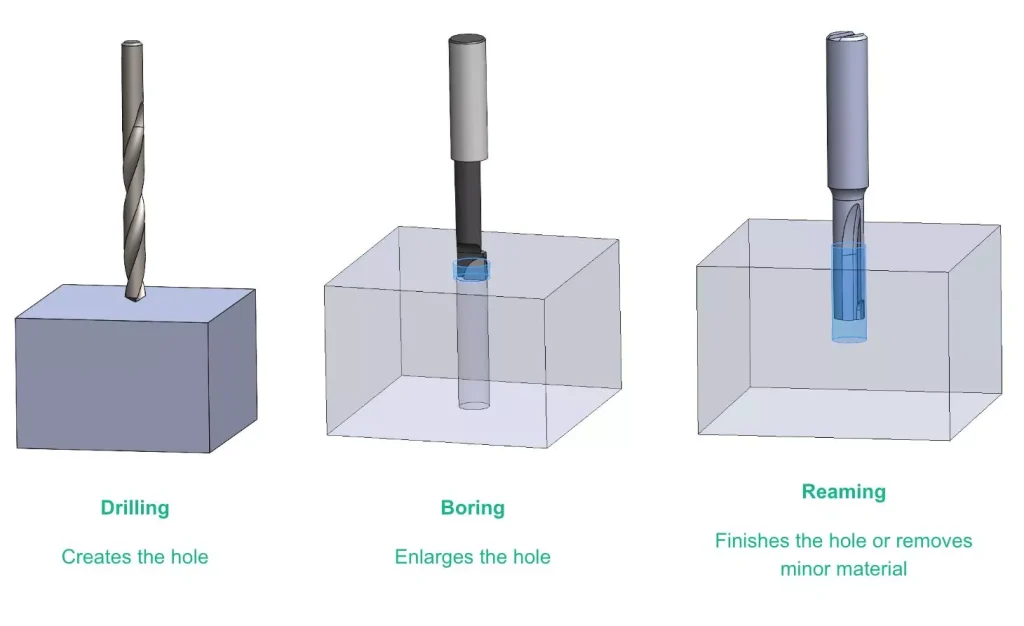
CNC Drilling
Drilling is usually the first step in hole machining. It creates holes quickly and efficiently and is suitable for a wide range of materials.
However, drilling alone may not achieve the tight tolerances or surface quality required for precision assemblies.
CNC Boring
Boring enlarges and improves existing holes by removing material from the internal surface. It provides better dimensional accuracy, alignment, and control compared with standard drilling.
It is commonly used for components requiring precise internal diameters, such as bearing housings and mechanical assemblies.
CNC Reaming
Reaming is a finishing operation used to achieve the final hole size and improve surface quality. It removes a small amount of material to produce highly accurate and smooth internal surfaces.
It is often used where precise fits are required between components.
CNC Milling vs CNC Grinding
CNC milling and CNC grinding are both used for precision machining, but they serve different purposes.
CNC milling is primarily used for creating part geometry and removing larger amounts of material, while grinding is mainly a finishing process used to achieve extremely accurate dimensions and surface finishes.
| Feature | CNC Milling | CNC Grinding |
| Main Purpose | Shape creation | Precision finishing |
| Material Removal | Higher | Lower |
| Accuracy | High | Very High |
| Surface Finish | Good | Excellent |
| Typical Use | General precision machining | Final finishing operations |
CNC Milling
Milling is more suitable when a part requires complex shapes, pockets, holes, or multiple features. It provides higher material removal efficiency and greater design flexibility.
CNC Grinding
Grinding is selected when extremely tight tolerances or superior surface finishes are required. It is commonly used for hardened materials that are difficult to machine with conventional cutting tools.
Typical applications include:
- Precision shafts
- Hardened components
- Tooling parts
- Wear-resistant components
CNC Machining vs EDM
CNC machining and EDM are both capable of producing precision components, but they use completely different material removal methods.
Traditional CNC machining removes material through mechanical cutting, while EDM uses controlled electrical discharges to erode conductive materials.
| Feature | CNC Machining | EDM Machining |
| Cutting Method | Mechanical cutting tools | Electrical discharge |
| Contact | Tool contacts workpiece | No direct cutting force |
| Material Capability | Wide range of materials | Hard conductive materials |
| Speed | Generally faster | Generally slower |
| Best For | General precision parts | Complex hard features |
CNC Machining
CNC machining offers high efficiency and can process a wide range of metals and plastics. It is suitable for most precision manufacturing applications.
EDM
EDM is especially valuable for machining hardened materials, intricate internal features, and complex geometries that are difficult to produce using traditional cutting tools.
Typical applications include:
- Mold components
- Precision tooling
- Complex cavities
- Hard metal parts
CNC Turning vs Swiss Machining
CNC turning and Swiss machining are both used for rotational components, but they are designed for different part sizes and production requirements.
Swiss machining is a specialized turning process that provides additional support for small-diameter, high-precision components.
| Feature | CNC Turning | Swiss Machining |
| Best For | General rotational parts | Small precision components |
| Workpiece Support | Chuck holding | Guide bushing support |
| Part Size | Medium to large parts | Small diameter parts |
| Precision | High | Very High |
| Production | General production | High-volume precision production |
CNC Turning
Conventional CNC turning is suitable for a wide range of cylindrical parts, including shafts, fittings, and sleeves. It provides efficient machining and good surface quality.
Swiss Machining
Swiss machining is ideal for long, slender, and small-diameter components where vibration control and high precision are critical.
Typical applications include:
- Medical components
- Electronic connectors
- Precision pins
- Miniature mechanical parts
How to Choose the Right CNC Machining Process?
Selecting the right CNC machining process is not simply about choosing the most advanced machining method. The best option depends on the part design, material, tolerance requirements, surface finish, production volume, and overall project goals.
A suitable machining process can improve manufacturing efficiency, reduce production costs, and ensure the final part meets functional requirements. The following factors can help engineers determine the most appropriate CNC machining solution.
Consider Part Geometry and Features
The shape and design features of a component are usually the first factors to consider when selecting a CNC machining process.
For cylindrical or rotational parts, CNC turning is often the most efficient choice because the rotating workpiece allows continuous cutting. Components such as shafts, bushings, and threaded fittings are commonly produced through turning.
For parts with complex shapes, pockets, slots, angled surfaces, or multiple features, CNC milling provides greater flexibility. When a component requires machining from multiple directions or includes complex curved surfaces, multi-axis CNC machining may be more suitable.
Hole requirements also influence process selection. Simple holes can usually be created through drilling, while tighter tolerances or improved surface finishes may require boring or reaming operations.
Evaluate Material Requirements
Material properties play an important role in determining the most suitable machining method.Soft metals and plastics are generally easier to machine using conventional CNC milling and turning processes. Materials such as aluminum, brass, and engineering plastics offer good machinability and can be processed efficiently with standard cutting tools.
Harder materials, including hardened steel, titanium alloys, and other difficult-to-machine metals, may require specialized approaches. For example, grinding can achieve precise finishes on hardened materials, while EDM is often selected for complex features in electrically conductive materials that are difficult to cut mechanically.
Define Accuracy and Surface Finish Requirements
Different machining processes provide different levels of precision and surface quality.
For general-purpose components, CNC milling and turning can typically achieve the required dimensional accuracy. However, parts requiring extremely tight tolerances, smooth surfaces, or precise fits may need additional finishing processes.
For example:
- CNC boring improves hole accuracy and alignment.
- CNC reaming provides precise final hole dimensions.
- CNC grinding achieves superior surface finishes.
- EDM creates highly detailed features without applying cutting forces.
Understanding the required tolerance and surface finish helps avoid unnecessary machining steps and control manufacturing costs.
Consider Production Volume and Cost
Production quantity is another important factor when choosing a CNC machining process.For prototypes and low-volume production, flexible processes such as CNC milling and turning are often preferred because they can quickly produce customized parts with minimal setup requirements.
For larger production runs, machining efficiency becomes more important. CNC turning, Swiss machining, and optimized multi-axis machining can reduce cycle times and improve consistency.
However, selecting a more advanced process does not always mean better results. For simple parts, using a high-end machining method may increase costs without providing additional value.
Balance Machining Capability and Project Requirements
The most effective CNC machining solution balances technical requirements with manufacturing efficiency.
Engineers should consider:
- Part geometry complexity
- Required tolerances
- Material characteristics
- Surface finish requirements
- Production quantity
- Lead time and budget
By evaluating these factors together, manufacturers can select the machining process that provides the best combination of quality, efficiency, and cost-effectiveness.
CNC Machining Process Selection Guide
| Requirement | Recommended Process |
| Complex geometries and multiple features | CNC Milling / 5-Axis Machining |
| Cylindrical components | CNC Turning |
| Basic hole creation | CNC Drilling |
| High-precision holes | CNC Boring / Reaming |
| Ultra-smooth surface finish | CNC Grinding |
| Hard materials and complex cavities | EDM Machining |
| Small precision components | Swiss Machining |
Choosing the correct CNC machining process is essential for achieving reliable part performance while maintaining manufacturing efficiency. With extensive CNC machining capabilities, Xtproto can help evaluate part designs and recommend the most suitable machining solution based on specific project requirements.
CNC Machining Services at Xtproto
Selecting the right CNC machining process is essential for achieving the required accuracy, surface quality, and production efficiency. However, successful part manufacturing also depends on advanced equipment, process control, and engineering experience.
Xtproto provides comprehensive CNC machining solutions, supporting precision prototypes, custom components, and production parts across various industries. With advanced CNC milling, CNC turning, multi-axis machining, and finishing capabilities, Xtproto helps customers choose and implement the most suitable machining process based on part requirements.
Key CNC machining capabilities include:
- 3-axis, 4-axis, and 5-axis CNC milling
- Precision CNC turning and turn-mill machining
- Tight tolerance machining down to ±0.01 mm, with precision capability up to ±0.005 mm
- Machining of aluminum, stainless steel, titanium, and other engineering materials
- Surface finishing and secondary processing support
From prototype development to production manufacturing, Xtproto provides an integrated CNC machining solution to help customers produce reliable, high-quality precision components.
Conclusion
CNC machining includes various processes, each designed for different manufacturing requirements. CNC milling is ideal for complex geometries and multi-feature components, while CNC turning provides efficient solutions for cylindrical parts. Other processes, such as drilling, boring, reaming, grinding, EDM, and Swiss machining, offer specialized capabilities for achieving specific accuracy, surface finish, and design requirements.
Choosing the right CNC machining process requires careful consideration of part geometry, material selection, tolerance requirements, surface finish, production volume, and cost. There is no single machining method that is suitable for every application—the best solution depends on balancing technical requirements with manufacturing efficiency.
With extensive CNC machining capabilities, advanced equipment, and engineering expertise, Xtproto helps customers select and implement the right machining solutions for prototypes and production parts. From precision milling and turning to complex multi-axis machining and secondary finishing, Xtproto supports the complete process from design evaluation to finished components.