The Economics of Precision Manufacturing: Decoding the Cost Structure of CNC Machining
In the realm of custom manufacturing, one of the most common perplexities encountered by engineers and procurement professionals is the vast disparity in CNC machining quotes. It is not uncommon to submit the exact same CAD file to three different machine shops and receive three wildly different quotes—sometimes with price gaps reaching as high as 200% to 300%.
To the uninitiated, this pricing chasm may appear arbitrary, or simply a reflection of differing profit margins among various shops. However, CNC pricing is by no means a product of guesswork. Rather, it is the result of a complex series of calculations that integrate a multitude of factors, ranging from machine tool physics and materials science to shop-floor production logistics. Behind every quote lies a “black box” composed of numerous variables—variables that determine how long a spindle must run, how many specialized cutting tools will be consumed, and the degree of technical risk the facility must assume.
This guide aims to demystify the process of quote estimation and eliminate the inherent ambiguity surrounding it. By gaining a deep understanding of the underlying cost structures—from the exponential cost increases driven by tight tolerances to the “Buy-to-Fly Ratio” of raw materials—engineers can effectively bridge the gap between conceptual design and the realization of cost-effective physical parts.
Ultimately, our objective is not merely to seek out the lowest price, but to comprehend the “engineering logic behind the price tag.” By applying Design for Cost (DFC) principles during the early stages of product development, it is possible to optimize budgets without compromising the mechanical integrity or functional performance of the final part. Understanding *why* a specific part incurs a specific cost is the essential first step toward achieving more efficient manufacturing.
The Architecture of a Quote: Fixed vs. Variable Costs
A CNC machining quote is primarily composed of two distinct financial layers: the non-recurring engineering (NRE) costs associated with setup, and the variable costs associated with actual production. Understanding how these two layers interact is essential for accurately forecasting project budgets.
Setup Costs: The “Hidden Tax” on Small Batches
The most significant factor in low-volume production is the setup time. Before a single chip is cut, a series of technical tasks must be completed:
- CAM Programming: An engineer must translate the CAD model into G-code, selecting tool paths and determining the optimal machining strategy.
- Fixture Engineering: Depending on the part’s geometry, custom jigs or fixtures may need to be designed and machined just to hold the workpiece in place.
- Machine Calibration: Tools must be loaded, offsets measured, and the first part “proved out” to ensure the program is error-free.
Because these tasks take the same amount of time whether you are making one part or one thousand, the “per-part” cost for a single prototype is often dominated by these fixed expenses.
The Hourly Rate Fallacy
It is a common misconception that the lowest “Shop Rate” (the hourly cost of running a machine) yields the lowest quote. However, the shop rate is only half of the equation; the other half is efficiency.
A modern, high-speed 5-axis machining center may have a significantly higher hourly rate than an older 3-axis mill, but if it can complete a part in one setup instead of five, the total labor time—and thus the final price—is often lower. The quote is a reflection of how effectively a shop can minimize “spindle-down” time.
Tooling and Consumables
Finally, variable costs include the wear and tear on cutting tools. Machining abrasive or hard materials, such as Titanium or Inconel, necessitates specialized carbide or ceramic tools that have a finite lifespan. In high-volume orders, the cost of tool replacement and the time taken for tool changes become measurable variables in the pricing model.
Precision vs. Price: The Law of Diminishing Returns
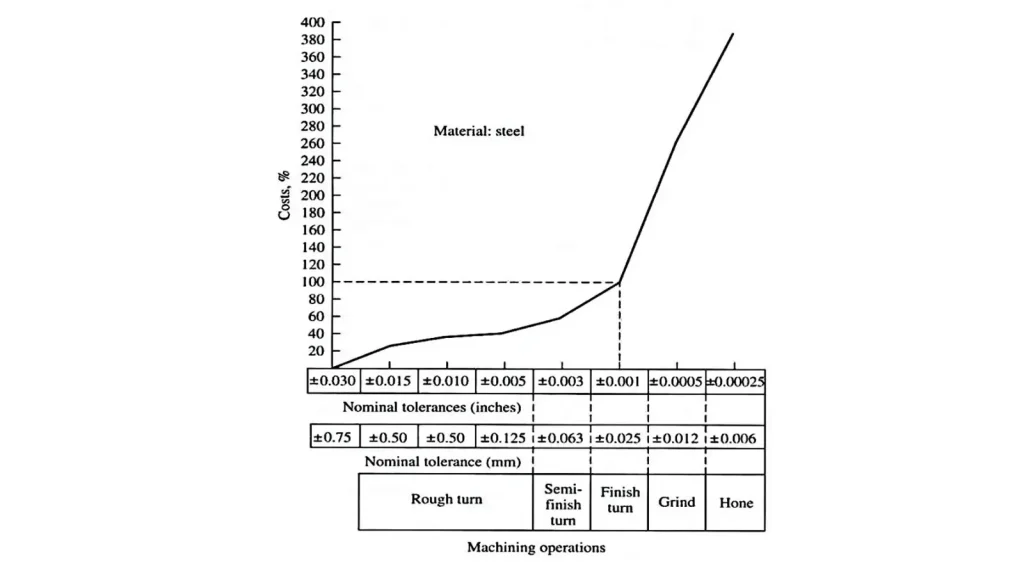
In CNC machining, there is a common misunderstanding that precision is a linear commodity. Many project owners assume that tightening a tolerance by half will simply lead to a marginal increase in cost. In reality, the relationship between precision and price is exponential.
The Exponential Cost Curve
As tolerances move from standard (e.g., $\pm0.1mm$) to high-precision (e.g., $\pm0.005mm$), the machining process enters a different tier of complexity. Achieving these tighter limits is not just about the machine’s capability; it is about controlling every variable in the environment. At the micron level, even a slight change in ambient temperature can cause material expansion that throws a part out of spec. Consequently, high-precision work often requires climate-controlled facilities, specialized vibration-dampening foundations, and slower, multi-pass machining strategies.
The Inspection Overhead
Precision is only as good as the ability to measure it. Standard calipers or micrometers are insufficient for verifying sub-micron features. When a quote includes tight tolerances, it also includes the cost of metrology:
- CMM Verification: Coordinate Measuring Machines (CMM) require dedicated programming time and controlled environments.
- Specialized Gauging: Custom go/no-go gauges or air gauges may need to be procured specifically for the project.
- Documentation: High-precision industries (such as aerospace or medical) typically require full inspection reports for every single unit, adding a significant administrative layer to the labor cost.
Tolerance Sensitivity
A frequent driver of unnecessary expense is “over-tolerancing.” This occurs when a designer applies a blanket high-precision tolerance to an entire drawing, including non-critical features like clearance holes or chamfers. Since the machine shop must treat every dimension as a requirement, the time spent chasing unnecessary precision on a non-functional surface is reflected directly in the final price tag. Understanding the “Goldilocks Zone”—where the tolerance is tight enough for function but loose enough for efficient manufacturing—is the most effective way to manage a machining budget.
Geometric Complexity and Machining Physics
In a digital CAD environment, adding a complex internal feature or a deep slot is as simple as a few clicks. However, translating these digital geometries into a physical part requires navigating the rigid laws of machining physics. Complexity is one of the most significant cost drivers because it directly dictates tool selection, the number of setups, and the risk of tool failure.
Cavity Depths and Aspect Ratios
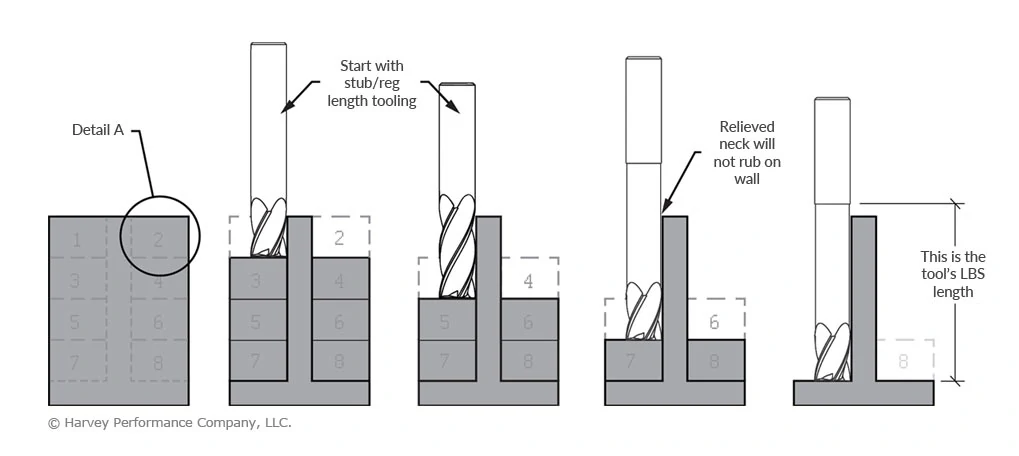
One of the primary challenges in milling is the aspect ratio—the relationship between a cavity’s depth and its width. As a hole or slot becomes deeper, the cutting tool must be longer. Long, slender tools are prone to deflection (bending) and vibration (chatter). To maintain accuracy and prevent tool breakage, machinists must drastically reduce feed rates and taking much lighter cuts. A slot that is five times deeper than the tool’s diameter can take ten times longer to machine than a standard shallow pocket.
Internal Fillet Logic
CNC milling is fundamentally a process of rotating round tools. This means that a square internal corner is a physical impossibility without specialized processes like EDM (Electrical Discharge Machining). When a design specifies sharp internal corners, it forces the shop to use the smallest possible end mill, which is both fragile and slow. By increasing internal fillet radii—ideally to a size slightly larger than a standard tool radius—engineers allow the tool to transition through corners without slowing down, significantly reducing cycle time.
Thin-Wall Stability and Deformation
As parts become lighter and more complex, thin-walled sections ($<0.5mm$) have become more common. The challenge here is structural integrity during the machining process. The pressure exerted by the cutting tool, combined with the release of internal stresses in the material, can cause thin walls to warp or vibrate. Machining these features requires specialized, multi-stage “stepping” strategies to support the material as it is thinned. The increased attention and reduced speeds required to prevent deformation are reflected in the final quote.
Multi-Sided Setups vs. 5-Axis Logic
Every time a part needs to be flipped or rotated to access a new face, a new “setup” is required. Each setup involves manual labor for part handling and alignment. This is where 5-axis machining changes the economic equation. While the hourly rate for a 5-axis machine is higher, its ability to reach multiple faces in a single setup often makes it the more cost-effective choice for complex geometries by eliminating the cumulative labor costs of multiple manual re-positionings.
Material Science and Machinability
In the budgeting phase, there is a common tendency to focus on the raw market price of a material per kilogram. However, in CNC machining, the “machinability” of a metal often has a far greater impact on the final invoice than the cost of the stock itself. The harder a material is to cut, the more machine time it consumes and the more specialized tooling it destroys.
The Machinability Index
Every material is assigned a machinability rating, usually expressed as a percentage relative to AISI 1212 steel (the industry standard).
- Aluminum Alloys (e.g., 6061, 7075): These possess high machinability ratings. They allow for aggressive feed rates and high spindle speeds, resulting in shorter cycle times and lower costs.
- Stainless Steels (e.g., 304, 316): These are far more challenging. They are prone to work-hardening and have lower thermal conductivity, meaning heat stays at the cutting edge. This necessitates slower speeds and more frequent tool replacements.
- Superalloys and Titanium: Materials like Grade 5 Titanium or Inconel are “difficult-to-cut” by nature. They require rigid setups, specialized coatings on carbide tools, and ultra-slow machining passes, which exponentially increases the spindle time reflected in the quote.
The “Buy-to-Fly” Ratio: Accounting for Waste
A critical but often overlooked economic factor is the buy-to-fly ratio—the weight of the raw material purchased versus the weight of the finished part. If a design requires a large amount of material removal (e.g., a hollowed-out aerospace bracket), the cost includes not only the wasted material but also the hours of machine time spent turning that material into chips. In some complex components, the buy-to-fly ratio can be as high as 10:1 or 20:1, making the raw material choice a massive leverage point for cost reduction.
Raw Material Form Factors
The physical shape of the starting material also dictates the initial cost. Standard plate or bar stock is economical and readily available. However, if a part’s dimensions fall just outside standard stock sizes, it may require custom-ground stock or oversized blocks that need hours of “squaring up” before the actual feature machining can begin. Designing parts to fit within standard material form factors is a subtle but effective way to lower the initial entry price of a project.
Beyond the Spindle: Secondary and Invisible Costs
A common oversight in project estimation is focusing solely on the time a part spends under the cutting tool. In a professional production environment, “spindle time” is only one component of the value chain. Secondary operations and administrative requirements often carry significant cost weight, yet they are the least visible in the initial design phase.
Surface Topography and Aesthetic Finishes
The “As-Machined” state is the most economical finish, but it often leaves visible tool marks (typically Ra 3.2 or 1.6). When an application requires a specific aesthetic or functional surface, costs increase based on the labor involved:
- Batch Processes: Operations like bead blasting or tumbling are relatively cost-effective as they can be done in bulk.
- Chemical Treatments: Anodizing, passivation, or powder coating require specialized chemical baths. These are often outsourced to certified vendors, adding logistics costs and minimum batch charges to the quote.
- High-Luster Polishing: Hand-polishing or mirror-finishing is extremely labor-intensive. The price reflects the manual hours required to achieve a defect-free surface.
The Labor of Complexity: Deburring and Assembly
Every CNC process creates burrs—small ridges of displaced metal at the edges of a cut. While simple parts can be deburred automatically, complex geometries with intersecting holes or internal features often require manual deburring under a microscope. Furthermore, if a project requires the installation of threaded inserts (Helicoils), press-fit bearings, or basic assembly, the labor rate for these manual steps is calculated separately from the machine’s hourly rate.
Quality Assurance and Compliance Documentation
In regulated industries such as aerospace, medical, or defense, the part itself is only half of the deliverable; the other half is the data. The cost of a project scales with the level of documentation required:
- Certificate of Conformance (CoC) & Material Test Reports (MTR): Standard for ensuring traceability.
- First Article Inspection (FAI): A comprehensive report where every single dimension on the drawing is measured and recorded for the first production unit.
- Non-Destructive Testing (NDT): Processes like X-ray or dye penetrant inspection to find internal flaws.
These “invisible” costs are non-negotiable in high-stakes applications and are a primary reason why a medical-grade component costs significantly more than a visually identical consumer-grade part.
Strategic Conclusion: Constructing the Final Price
Understanding the various variables that influence a CNC machining quote is far more than a mere cost-accounting exercise; it serves as a strategic tool that facilitates superior engineering design. As we have explored, the price of a component is rarely a fixed figure determined solely by machining volume. Instead, it is a dynamic value—one shaped by the interplay of machine tool physics, material limitations, and the level of technical risk inherent in the design itself.
The Value of Early-Stage DFM
The most effective method for optimizing a machining budget is not to blindly chase the lowest hourly machine rates, but rather to engage in collaborative “Design for Manufacturability” (DFM) during the early stages of the design process. When engineers fully grasp the key cost drivers—such as the exponential cost increases associated with tight tolerances, or the cost penalties incurred by high aspect-ratio structures—they are empowered to make informed trade-offs during the prototyping phase. Often, a simple tweak to a fillet radius or a slight relaxation of tolerance requirements on non-critical dimensions can yield significant cost savings without compromising the component’s ultimate functional utility.
Moving Beyond a “Transactional” Mindset
A professional CNC machining quote represents far more than a simple financial transaction; it is a concentrated reflection of technical expertise and process control capabilities. While it may be tempting to treat machining services as a mere “commodity,” the hidden costs arising from quality defects, material non-compliance, or delayed deliveries often far outweigh the superficial savings initially gained by accepting a low-ball quote.
In summary, cost-effective components are the inevitable result of a balanced design approach. If project managers and engineers view the manufacturing process as a series of “economic decisions” rather than purely “mechanical decisions,” they can ensure that every dollar invested truly translates into superior performance, rather than paying for unnecessary complexity. The path to success in CNC procurement lies in finding that perfect “Goldilocks Zone”: a design that possesses the precision required to meet performance demands while being fully optimized to ensure an efficient manufacturing process.