How Does Material Density Affect CNC Machined Parts?
Material density is a critical factor when selecting materials for CNC-machined parts. It determines the weight of a part for a given volume, thereby influencing equipment performance, motion system inertia, shipping costs, and the total weight of the assembly. When considering density, one must also balance mechanical properties and machining requirements; lightweight materials are not necessarily easier to machine, nor are high-density materials necessarily more difficult to cut.
Understanding how density affects CNC-machined parts helps engineers make better material selection decisions before manufacturing begins.
What Is Material Density?
Material density refers to the mass contained within a unit volume. It is typically expressed in grams per cubic centimeter (g/cm³) or kilograms per cubic meter (kg/m³).
The relationship is straightforward: density equals mass divided by volume.
Here, density represents the mass per unit volume of the material; mass is the amount of matter an object contains; and volume is the amount of space the object occupies.
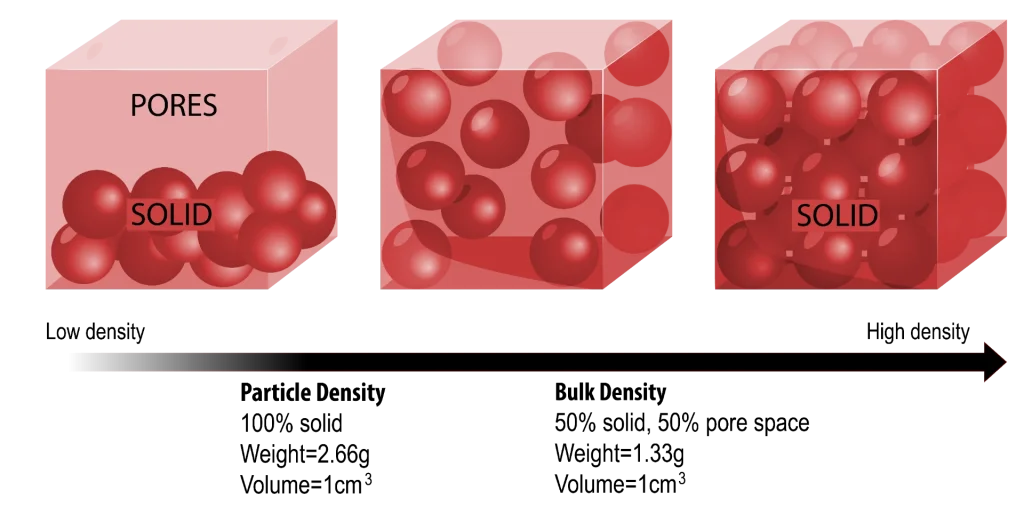
For two components with identical external dimensions, the one made from a denser material will usually weigh more. For instance, the density of aluminum is approximately 2.7 g/cm³, whereas the density of steel typically ranges from 7.8 to 8.0 g/cm³. Consequently, a solid steel component of a given volume may weigh nearly three times as much as an aluminum component of the same volume.
This difference is particularly significant when designing components that require high-speed movement, ease of handling, the ability to withstand specific loads, or adherence to strict weight limits. Density alone does not determine whether a material is suitable for a specific application; factors such as strength, stiffness, wear resistance, corrosion resistance, thermal properties, and operating conditions must also be considered.
How Does Material Density Affect the Weight of CNC Machined Parts?
The most direct effect of material density is on finished-part weight. If two parts have the same volume but are made from materials with different densities, their masses will differ in proportion to those densities.
Consider a CNC machined component with a finished volume of 100 cm³. If it is made from aluminum with a density of 2.7 g/cm³, its approximate mass is 270 g. If the same volume is machined from steel with a density of 7.9 g/cm³, the mass is approximately 790 g.
That is a difference of about 520 g for a single component. In a small fixture, this may be manageable. In a robotic arm, aerospace assembly, or high-speed positioning system containing dozens of components, the combined weight difference can become significant.
For lightweight applications, aluminum, magnesium, and certain engineering plastics may help reduce mass. Titanium can also provide a useful balance of relatively low density and high specific strength, although its machining behavior and material cost require separate consideration.
The important point is that material selection should begin with the required function of the part, not density alone. A lighter component must still meet its load-bearing, dimensional, durability, and service-life requirements.
How Density Influences the Performance of Moving Components
Weight is a critical factor when CNC-machined parts are used in motion assemblies—such as robotic joints, automated grippers, pick-and-place equipment, gimbal systems, and aerospace mechanisms. Heavier components generally impose greater loads on motors, actuators, bearings, and supporting structures. When a component accelerates or changes direction, its mass directly influences the force required to drive it. Mass distribution is equally vital in rotational systems: material located further from the axis of rotation contributes more significantly to the moment of inertia than material closer to the center.
Reducing density is highly beneficial for components that undergo frequent movement or operate at high speeds. For instance, a lighter robotic end-effector can improve system acceleration efficiency or reduce the load on the robot itself; in aerospace applications, lowering component mass helps meet overall weight-reduction targets.
However, substituting aluminum for steel is not always a universal solution. Aluminum has a lower modulus of elasticity than steel, meaning that—given identical geometry and loading conditions—aluminum components typically exhibit lower stiffness. To achieve the required stiffness, designs may need to incorporate increased wall thicknesses, additional ribs, or alternative structural layouts. Such design adjustments can partially offset the benefits gained from weight reduction. The most effective approach is to holistically consider density, stiffness, strength, geometry, and actual loading conditions.
Does Material Density Affect CNC Machining Difficulty?
While density does influence the machining process, it is not a reliable, standalone indicator of a material’s machinability.
During CNC milling or turning, cutting forces depend on a complex interplay of factors, including the material’s hardness, strength, ductility, work-hardening characteristics, and thermal conductivity, as well as tool geometry, cutting speed, feed rate, and depth of cut. Although density may correlate with certain material properties within specific categories, it does not directly determine how difficult it is for a cutting tool to remove material.
For instance, aluminum has a relatively low density and is generally easy to machine with the right tools and parameters. However, improper cutting conditions can still lead to issues such as built-up edge (BUE), chip adhesion, or burrs. Titanium is denser than aluminum but significantly less dense than steel. Despite this moderate density, certain titanium alloys are notoriously difficult to machine due to their poor thermal conductivity, high strength at elevated temperatures, and a tendency for heat to concentrate near the cutting edge; consequently, tool wear and heat management are often more critical factors than density itself. Tungsten alloys present a different scenario: their extremely high density makes them invaluable for applications requiring compact counterweights or radiation shielding, yet the difficulty of machining them depends on specific alloy composition, hardness, toughness, and manufacturing state.
Engineers should not select tools or determine machining parameters based on density alone; instead, they must comprehensively consider the material grade, heat treatment condition, part geometry, and the specific machining operations involved.
How Density Affects Material Removal and Machining Cost
Density also influences material planning and handling costs, although its impact on machining costs is indirect.
For parts with a fixed finished volume, materials with higher density result in a higher finished part mass. If procurement and pricing are based on weight, density affects material costs; however, the actual cost also depends on the unit price (price per kilogram), availability, stock form, and required certifications.
Material removal is another factor to consider. CNC machining typically begins with a raw stock (such as a block or bar) that is larger than the final part. The difference between the initial stock and the final geometry constitutes the chips or other removed material.
For lightweight parts featuring deep cavities or thin-walled structures, a significant amount of material may need to be removed despite the low finished mass; conversely, a high-density part with a compact geometry might require relatively little machining. Therefore, the weight of the finished part alone cannot determine material consumption or the time required for machining.
The ratio of initial material volume to finished part volume is often used to assess material utilization. When a design requires extensive machining of expensive stock, engineers might consider using near-net-shape blanks, more suitable initial forms, or modifying the geometry—without compromising functionality—to reduce unnecessary material removal.
For high-density materials, the weight of the stock also affects loading, workholding, in-shop transport, and safe handling. Even if the material has good machinability, these factors can influence production planning.
How Material Density Affects Different CNC Machining Materials
Different material families offer different combinations of density and engineering performance. The right choice depends on the part’s intended function.
| Material | Approximate density | Typical considerations for CNC machined parts |
| Aluminum alloys | 2.7 g/cm³ | Low weight, good machinability for many grades, widely used in housings, brackets, and structural components |
| Magnesium alloys | 1.7–1.9 g/cm³ | Very low weight; material-specific fire and chip-handling precautions are essential |
| Titanium alloys | 4.4–4.5 g/cm³ | High specific strength and corrosion resistance in many environments; heat management and tool wear require attention |
| Steel | 7.8–8.0 g/cm³ | Broad range of strength, hardness, and wear properties; suitable for many load-bearing and mechanical components |
| Copper | 8.9 g/cm³ | High electrical and thermal conductivity; selection depends on conductivity, strength, and machining requirements |
| Brass | 8.4–8.7 g/cm³ | Often good machinability, with properties varying by alloy and application |
| Tungsten | Approximately 19.3 g/cm³ | Very high density for compact weighting and specialized applications; machining strategy depends on material form and grade |
| Engineering plastics | Varies by polymer | Generally low weight and useful for electrical insulation, chemical resistance, or low-friction applications, depending on the polymer |
These values are approximate and vary with alloy composition, grade, and material condition. They should be used for initial comparison rather than as substitutes for a material specification.
Aluminum: When Weight Reduction Matters
Aluminum is widely used for CNC machined housings, mounting brackets, heat sinks, and structural components because it combines low density with useful strength and generally good machinability. It is often a practical option when reducing weight is important but the component still needs adequate rigidity and dimensional stability.
The specific alloy matters. Different aluminum grades offer different combinations of strength, corrosion resistance, machinability, and surface-treatment response.
Steel: When Load Capacity and Durability Take Priority
Steel is considerably denser than aluminum, but it offers a broad range of mechanical properties. Depending on the grade and heat treatment, it may be appropriate for shafts, fixtures, mechanical supports, and wear-resistant components.
Where weight is not the dominant design constraint, steel may provide a suitable balance of stiffness, strength, durability, and manufacturing practicality. The decision should be based on the loads and operating conditions the part must withstand.
Titanium: When Low Weight Must Be Balanced With High Performance
Titanium alloys are often selected for components requiring high specific strength, corrosion resistance, or performance under demanding operating conditions. Their density is higher than aluminum’s but lower than steel’s, making them useful when both mass and mechanical performance matter.
However, titanium machining requires careful control of cutting conditions, tool engagement, and heat generation. A density comparison cannot predict the machining cycle time or tool life.
Engineering Plastics: When Low Mass and Functional Properties Matter
Engineering plastics such as POM, PEEK, and nylon are commonly considered for lightweight components, insulating parts, guides, bushings, and other applications where metal properties may not be necessary. Their densities are generally lower than those of metals, but their stiffness, thermal expansion, moisture response, and temperature limits differ significantly.
A plastic part may weigh much less than a metal equivalent while requiring design adjustments to maintain stiffness and dimensional stability. Material selection should reflect the operating environment and the part’s functional requirements.
Can CNC Machining Reduce Part Weight Without Changing Material?
Yes. Weight reduction can often be achieved by optimizing the part’s geometry, even when the material remains the same.
CNC milling allows for the machining of cavities, pockets, channels, and other features in non-critical areas to remove excess material. This reduces the component’s mass while preserving material around mounting points, load-bearing sections, and functional interfaces.
Weight reduction does not simply mean removing as much material as possible. Thin-walled structures may deform during machining or under operational loads; deep cavities increase requirements for tool overhang and machining time; and narrow ribs are prone to vibration or deformation if not machined correctly. Furthermore, the final geometric design must ensure tool accessibility and compliance with tolerance requirements.
For components subject to significant loads, designs involving material removal must account for load direction, stiffness requirements, stress concentrations, and support conditions. In some cases, combining a lighter material with optimized geometry yields better results than simply switching materials; in other instances, retaining a denser material while selectively removing material from non-critical areas proves more effective.
The primary design objective is to achieve the required strength, stiffness, and functionality with minimal redundant mass, rather than merely selecting the material with the lowest density.
How to Select the Right Density for a CNC Machined Part
Material density should be evaluated as part of the overall engineering requirements.
First, consider the part’s function. If the part is part of a moving mechanism, mass and inertia may be critical; if it must withstand heavy loads or maintain alignment under stress, stiffness and strength may play a more significant role in the decision; if the part operates in corrosive environments or at high temperatures, these conditions—rather than just density—may limit material choices.
Next, evaluate the geometry. Considerations regarding material utilization for a large housing with extensive internal cavities differ vastly from those for a small, solid shaft. Wall thickness, unsupported spans, mounting features, and the volume of material to be removed all influence the final weight and manufacturing approach.
Finally, consider manufacturing and inspection requirements. Material grade, raw material availability, machinability, achievable tolerances, surface finish, and any necessary post-processing steps all impact total cost and lead times. If the lowest-density option necessitates extensive redesign, complicates machining, or adds inspection overhead, it may not be the most economical choice.
An effective material selection process should strike a balance between weight, mechanical properties, operating conditions, manufacturability, and overall production requirements.
How Xtmade Evaluates Material Selection for CNC Machined Parts
Xtmade manufactures custom CNC machined parts based on customer-provided drawings, CAD files, samples, and specifications. When material density is a relevant design consideration, it should be assessed alongside the part’s geometry, mechanical requirements, and intended operating environment.
During manufacturing planning, the material choice is considered in relation to stock dimensions, material removal, workholding, machining operations, and inspection requirements. For lightweight components, this may include reviewing whether pockets, wall thicknesses, or other features can achieve the required mass without compromising structural performance. For denser materials, stock handling and material utilization may also be relevant to production planning.
The objective is not to choose the lightest or heaviest material by default. It is to manufacture parts that meet the specified functional and dimensional requirements while keeping material selection and machining strategy aligned with the application.
Conclusion
Material density affects CNC machined parts most directly through weight, but its engineering implications extend to moving-system performance, material utilization, stock handling, and overall design decisions. A lower-density material can help reduce mass, while a denser material may be appropriate when its other mechanical or functional properties better meet the application requirements.
Xtmade manufactures custom parts according to customer-provided drawings and specifications. By considering density together with material properties, part geometry, machining requirements, and intended operating conditions, we help align manufacturing decisions with the functional needs of each component. The goal is to achieve the required weight and performance without compromising dimensional accuracy, structural integrity, or consistent part quality.