Ultimate Guide to CNC Grinding: Precision and Mechanics
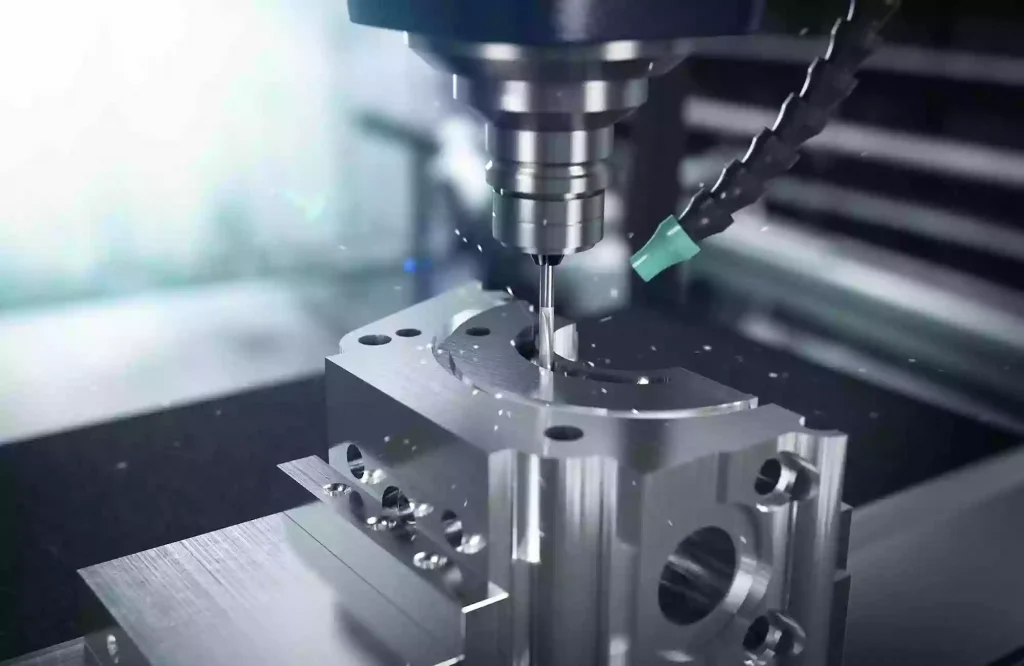
CNC (Computer Numerical Control) grinding is a precision machining process that removes material from a workpiece using a rotating abrasive wheel. While standard CNC milling and turning are ideal for bulk material removal, CNC grinding is typically the final step in the manufacturing process. It is used when a project requires exceptionally tight tolerances, complex geometries, or a highly refined surface finish that conventional cutting tools cannot achieve.
In modern manufacturing industries—such as aerospace, medical, and automotive—components must withstand extreme stress and fit together with absolute predictability. CNC grinding meets these demands by operating at a micron-level scale, ensuring that critical parts perform reliably under the most demanding conditions.
How CNC Grinding Works
To fully understand the advantages of CNC grinding, it is important to examine how the process removes material, how machine movements are controlled, and how heat generated during grinding is managed.
Abrasive Material Removal
Unlike CNC milling or turning, which remove material using defined cutting edges, CNC grinding relies on a rotating grinding wheel made up of countless abrasive particles bonded together. Common abrasive materials include aluminum oxide, silicon carbide, cubic boron nitride (CBN), and diamond.
As the wheel rotates at high speed, each abrasive grain functions as a tiny cutting edge, removing microscopic amounts of material from the workpiece surface. Because material is removed in extremely small increments, CNC grinding can achieve exceptional precision, with tolerances reaching ±0.001 mm and surface finishes as fine as Ra 0.1–0.4 μm.
CNC-Controlled Precision
Modern CNC grinding machines eliminate much of the variability associated with manual grinding by using programmed digital controls. Through CNC programming, the machine coordinates wheel movement, workpiece positioning, and process parameters with high repeatability.
Key control functions include:
- Accurate Axis Movement: Multi-axis positioning systems guide the grinding wheel and workpiece with sub-micron precision, enabling the production of flat surfaces, cylindrical features, and complex contours.
- Automatic Wheel Compensation: As the grinding wheel gradually wears during operation, the machine automatically compensates for changes in wheel diameter, helping maintain dimensional accuracy and consistent cutting performance throughout production.
Heat Control and Coolant Management
Grinding generates substantial heat due to the intense contact between abrasive particles and the workpiece. Excessive temperatures can negatively affect both dimensional accuracy and material properties, potentially causing thermal distortion, surface burns, or micro-cracks.
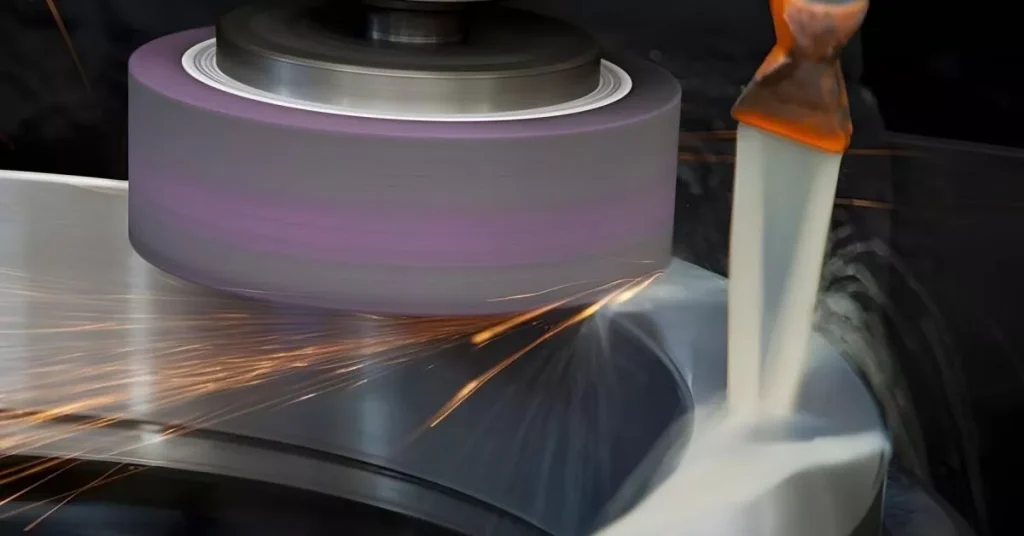
To minimize these risks, coolant is continuously delivered to the grinding zone under high pressure. The coolant performs several essential functions:
- Temperature Regulation: Removes heat from the grinding interface and helps prevent thermal expansion of the workpiece.
- Lubrication: Reduces friction between the wheel and the workpiece, improving grinding efficiency and extending wheel life.
- Debris Removal: Carries away swarf and worn abrasive particles, preventing wheel loading and maintaining consistent cutting performance.
Common Types of CNC Grinding
Different components require specific configurations to achieve their target geometries. CNC grinding machines are classified based on the surface they modify and how the workpiece is held during the process.
Surface Grinding
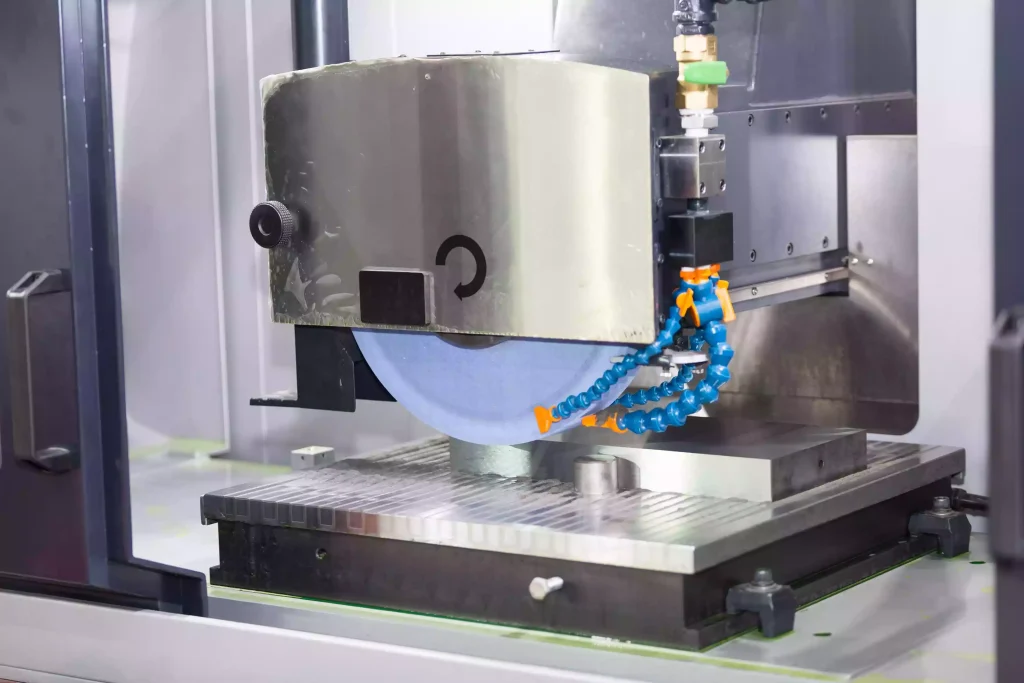
Surface grinding is used to create flat, smooth profiles on a workpiece. The machine uses a horizontal or vertical spindle that holds a rotating grinding wheel, while a reciprocating table moves the workpiece back and forth underneath it. This type is critical for squaring blocks, finishing mold plates, and ensuring precise parallelism between two surfaces.
Cylindrical Grinding
Cylindrical grinding is designed for processing parts with a central axis of rotation, such as shafts, tubes, and bearings. The workpiece is mounted between centers or held in a chuck and rotates while the grinding wheel moves along its exterior surface. This configuration ensures high concentricity and roundness over long cylindrical lengths.
Internal Grinding
As the name suggests, internal grinding focuses on finishing the inside diameters of straight, tapered, or formed holes. The setup requires a smaller grinding wheel that spins at much higher revolutions per minute (RPM) to maintain the necessary surface speed inside the bore. It is commonly used to finish bearing races, valve sleeves, and industrial bushings.
Centerless Grinding
Centerless grinding is a specialized high-volume production method for cylindrical parts that does not require the workpiece to be fixed by centers or a chuck. Instead, the part is supported by a work-rest blade and positioned between two wheels: a high-speed grinding wheel and a slower regulating wheel. The regulating wheel controls the rotation and linear feed of the part. This setup eliminates the risk of part deflection, making it highly efficient for processing long, thin pins, rods, and high-quantity automotive components.
5-Axis Tool and Cutter Grinding
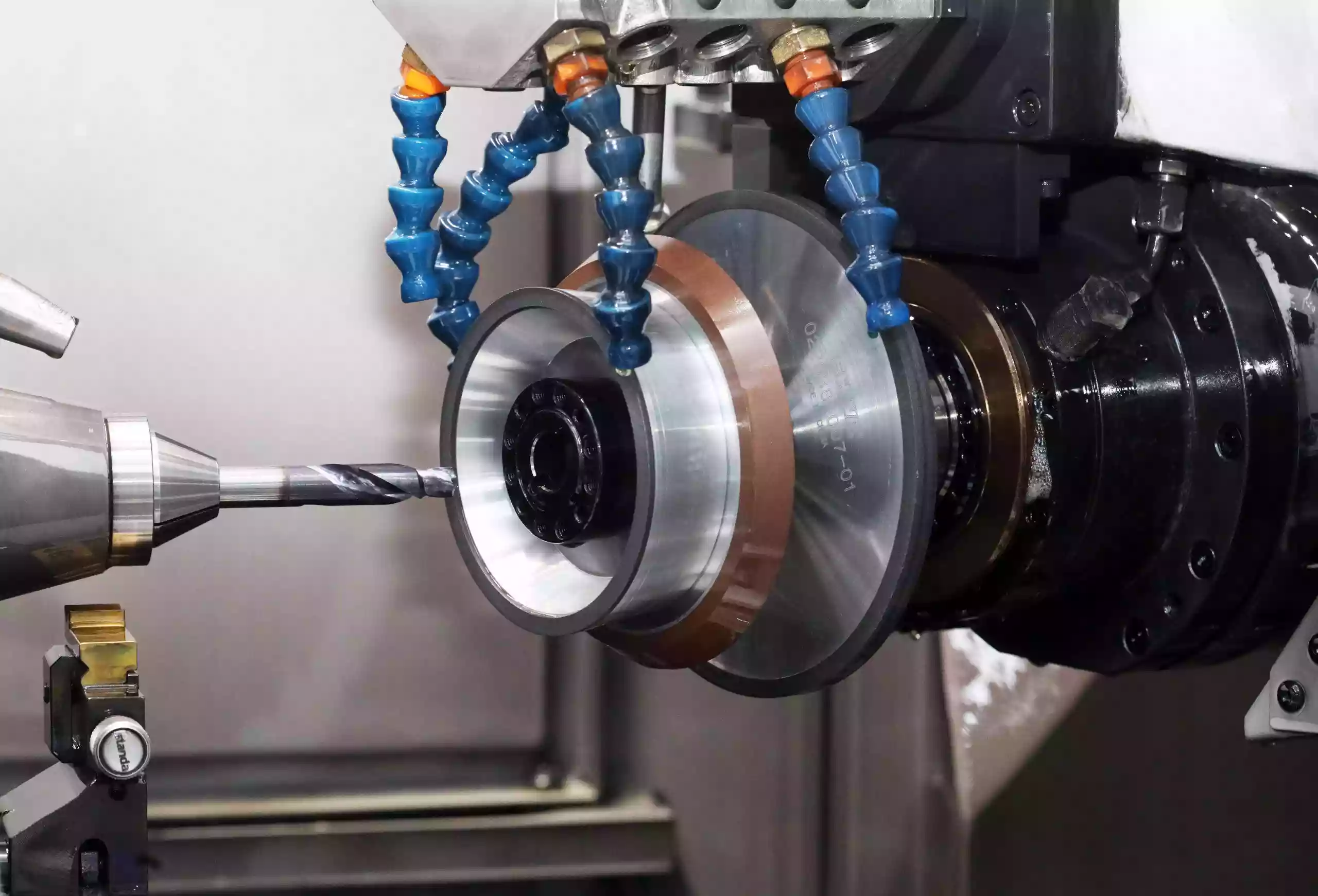
This advanced configuration involves multi-axis CNC movement to manufacture or sharpen complex cutting tools such as end mills, drills, and reamers. By moving across five axes simultaneously, the machine can generate precise helical flutes, relief angles, and intricate geometries on extremely hard materials like tungsten carbide and high-speed steel.
Key Advantages of CNC Grinding
Although CNC grinding generally involves slower material removal rates and more specialized equipment than milling or turning, it delivers a level of precision and surface quality that few other machining processes can match.
Exceptional Dimensional Accuracy
CNC grinding is capable of maintaining extremely tight tolerances, often within ±0.001 mm and even tighter under controlled manufacturing conditions. This precision is critical for components that require exact fits, precise alignment, or leak-free sealing performance.
Outstanding Surface Finish
The fine cutting action of abrasive grains produces exceptionally smooth surfaces, with typical roughness values ranging from Ra 0.1 to 0.4 μm. Improved surface quality helps reduce friction, minimize wear between mating components, and enhance long-term fatigue resistance.
Ideal for Hardened and Difficult-to-Machine Materials
Many materials become challenging to machine after heat treatment due to their increased hardness. CNC grinding easily handles hardened steels, superalloys, carbides, and advanced ceramics while maintaining accuracy and avoiding excessive tool wear.
Consistent Part-to-Part Repeatability
Modern CNC grinding machines continuously compensate for wheel wear and process variations throughout production. This automatic adjustment ensures consistent dimensions and surface quality across large production runs, making grinding an excellent choice for high-precision manufacturing.
Materials Suitable for CNC Grinding
CNC grinding is commonly used for materials that are too hard, brittle, or wear-resistant for efficient machining with conventional cutting tools.
Ferrous and Non-Ferrous Metals
Hardened Tool and Alloy Steels
Grinding is frequently performed after heat treatment to restore dimensional accuracy and remove distortion caused by the hardening process. It is widely used for dies, molds, shafts, gears, and precision tooling components.
Stainless Steel
High-alloy stainless steels often generate excessive heat and tool wear during conventional machining. CNC grinding provides greater process stability while achieving tight tolerances and superior surface finishes.
Titanium and Nickel-Based Superalloys
Materials such as titanium alloys and Inconel are valued for their strength and heat resistance but are notoriously difficult to machine. Grinding offers an effective finishing solution while minimizing tool degradation and maintaining dimensional accuracy.
Hard and Brittle Materials
Tungsten Carbide
Tungsten carbide is extensively used in cutting tools, wear components, and industrial dies. Due to its extreme hardness, carbide is typically finished using diamond grinding wheels rather than conventional cutting methods.
Advanced Technical Ceramics
Engineering ceramics such as alumina and silicon nitride provide exceptional thermal and wear resistance. CNC grinding enables precise shaping while reducing the risk of cracking or chipping associated with traditional cnc machining processes.
Glass and Quartz
Precision glass and quartz components used in optical, semiconductor, and scientific applications often require grinding to achieve accurate dimensions and controlled surface characteristics before final polishing operations.
Selecting the Right Grinding Wheel
The success of a CNC grinding operation depends largely on selecting the appropriate grinding wheel. Wheel performance is determined by several factors, including abrasive type, grit size, and bond material. Matching these characteristics to the workpiece material and desired finish is essential for achieving optimal results.
Abrasive Types
Different abrasive materials are designed for specific applications and workpiece materials.
Conventional Abrasives
Aluminum Oxide
Aluminum oxide is the most widely used grinding abrasive for ferrous metals. It provides a good balance of cutting performance, durability, and cost-effectiveness, making it suitable for carbon steels, alloy steels, and high-speed steels.
Silicon Carbide
Silicon carbide is harder and sharper than aluminum oxide but also more brittle. It is commonly used for cast iron, aluminum alloys, brass, copper, and certain non-metallic materials where fast cutting action is required.
Superabrasives
Cubic Boron Nitride (CBN)
CBN offers exceptional hardness and heat resistance, making it ideal for grinding hardened steels, tool steels, and nickel-based superalloys. It delivers long wheel life and consistent performance in high-volume production environments.
Diamond
As the hardest available abrasive, diamond is primarily used for materials that are extremely hard or abrasive, including tungsten carbide, advanced ceramics, glass, quartz, and composite materials.
Grit Size Selection
The grit size determines the balance between material removal rate and surface quality.
- Coarse Grits: Remove material quickly and are typically used for rough grinding operations.
- Medium Grits: Provide a balance between productivity and surface finish.
- Fine Grits: Produce smoother surfaces and tighter dimensional control during finish grinding.
Bond Types
The bond material secures abrasive grains within the wheel and influences cutting behavior, wheel life, and surface quality.
Vitrified Bonds
Vitrified wheels use ceramic-based bonding materials that provide excellent rigidity, thermal stability, and porosity. They are widely used in precision grinding applications where accuracy and coolant flow are critical.
Resin Bonds
Resin-bonded wheels offer greater flexibility and shock resistance. They are commonly selected for fine finishing, cutoff operations, and applications requiring superior surface finishes.
CNC Grinding vs. Milling and Turning
CNC grinding, milling, and turning each play distinct roles in the manufacturing process. While milling and turning are primarily used for shaping and bulk material removal, grinding is typically reserved for achieving final dimensions, tight tolerances, and superior surface finishes.
| Characteristic | CNC Milling & Turning | CNC Grinding |
| Primary Purpose | Material removal, shaping, and semi-finishing | Precision finishing and final sizing |
| Suitable Materials | Soft to moderately hard metals and plastics | Hardened steels, carbides, ceramics, and superalloys |
| Typical Hardness Range | Best suited for materials before heat treatment | Ideal for materials above 50 HRC |
| Surface Finish | Typically Ra 0.8–3.2 μm | Typically Ra 0.1–0.4 μm |
| Dimensional Accuracy | High precision for general machining | Ultra-high precision for critical features |
| Material Removal Rate | High productivity and rapid stock removal | Lower removal rate with superior control |
| Typical Production Stage | Roughing and semi-finishing | Final finishing and tolerance correction |
Process Synergy
In practical manufacturing, these processexs are rarely mutually exclusive. A typical workflow involves using CNC milling or turning to rough out the part shape while the material is soft, leaving a small amount of stock (grinding allowance). The part is then heat-treated to its final hardness, which often causes minor dimensional distortion. Finally, CNC grinding removes the remaining stock, correcting any distortion and bringing the part to its final specification.
Industry Applications
CNC grinding plays a critical role in industries where dimensional accuracy, surface integrity, and long-term reliability are essential. Its ability to produce tight tolerances and superior surface finishes makes it indispensable for high-performance applications.
Aerospace
Aerospace components frequently operate under extreme temperatures, pressures, and mechanical loads. Turbine shafts, fuel system components, landing gear parts, and other critical assemblies often require precision grinding to achieve exact dimensions, optimal surface quality, and consistent performance throughout their service life.
Medical Devices
Medical manufacturers rely on CNC grinding to produce components with exceptional accuracy and surface integrity. Orthopedic implants, surgical instruments, and minimally invasive medical devices often require ultra-smooth finishes to reduce friction, improve biocompatibility, and ensure reliable operation in demanding clinical environments.
Automotive
Many automotive powertrain and fuel system components depend on grinding as a final finishing process. Camshafts, crankshafts, transmission gears, bearing surfaces, and injector components are commonly ground to achieve the dimensional consistency and surface quality required for efficient, long-lasting performance.
Mold and Die Manufacturing
Precision molds, dies, and tooling components are typically manufactured from hardened tool steels that require grinding after heat treatment. Surface grinding, profile grinding, and internal grinding help restore dimensional accuracy, improve surface finish, and ensure the quality of the final molded or stamped products.
Industrial Machinery and Tooling
Grinding is also widely used in the production of bearings, hydraulic components, cutting tools, rollers, and wear-resistant parts. These applications often demand micron-level accuracy and excellent surface characteristics to maintain reliability under continuous operating conditions.
Conclusion
CNC grinding remains one of the most effective manufacturing processes for achieving ultra-tight tolerances, exceptional dimensional accuracy, and superior surface finishes. While milling and turning efficiently create the basic geometry of a component, grinding delivers the final precision required for demanding engineering applications.
At Xtmade, we combine advanced CNC grinding technology with precision milling and turning capabilities to provide a complete manufacturing solution. From hardened tool steels and aerospace superalloys to carbide and medical-grade materials, our team has the expertise to produce components that meet stringent dimensional and surface finish requirements.
Whether you need prototype quantities or full-scale production, Xtmade delivers consistent quality, reliable lead times, and precision you can trust. Contact our engineering team today to discuss your next CNC grinding project.