Understanding CNC Swiss Machining: Core Principles, Process Boundaries, and Design Specifications
In the field of modern precision manufacturing, machining miniature, high-accuracy components consistently introduces two fundamental mechanical challenges: material deflection caused by cutting forces and high-frequency vibration inherent in slender structures. When utilizing conventional CNC lathes for parts with a high length-to-diameter ratio or extremely small diameters, the extended cantilever of the workpiece introduces significant instability. As the cutting tool moves further from the chuck, the diminishing structural rigidity leads to part deflection, which compromises both dimensional tolerances and surface finish.
To bypass these mechanical rigidity limitations, CNC Swiss machining offers a fundamentally different kinematic approach. Originating in the 19th century to meet the production demands of the Swiss watchmaking industry, this technology has evolved through the integration of multi-axis CNC systems and live tooling. Today, it represents a highly efficient manufacturing method capable of executing turning, milling, drilling, and cross-tapping within a single setup.
The core distinction of Swiss machining lies in its departure from traditional axial cutting dynamics. By utilizing a synchronized combination of a guide bushing and a sliding headstock, the raw bar stock is continuously fed past the cutting tools, ensuring that material removal always occurs immediately adjacent to the rigid support point. This structural configuration eliminates the bending moments that typically degrade machining accuracy, enabling the volume production of components with micron-level tolerances and extreme length-to-diameter ratios. This article provides a systematic engineering analysis of Swiss machining technology, examining its mechanical architecture, process advantages, physical limitations, design for manufacturability (DFM) guidelines, and economic viability.
Core Principles and Mechanical Architecture
To understand the capabilities of Swiss machining, it is necessary to analyze the mechanical divergence between conventional CNC turning and the Swiss kinematic method. The fundamental difference lies in how the workpiece is supported and moved relative to the cutting tools.
The Two Core Mechanisms of a Swiss Machine
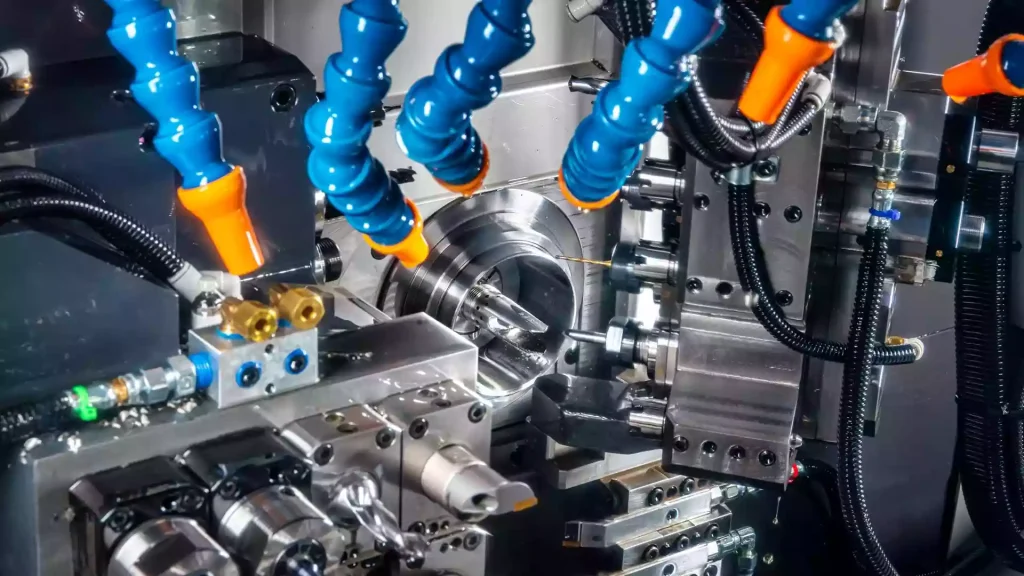
A CNC Swiss lathe relies on a synchronized, dual-component system to manage the raw material during the cutting cycle:
The Sliding Headstock: Unlike a fixed conventional spindle, the Swiss headstock is mounted on linear guides, allowing it to move dynamically along the Z-axis. The raw bar stock is clamped inside the headstock collet, and the entire spindle assembly advances or retracts to feed the material forward into the machining zone.
The Guide Bushing: This is a high-precision, stationary or rotating sleeve located at the front of the machining area. The bar stock passes through the sliding headstock and slips directly through the ID of the guide bushing. The guide bushing remains rigid, providing radial support to the material right before it encounters the cutting tools.
Kinematic Comparison: Swiss vs. Conventional Lathes
The structural variance alters how cutting forces impact the workpiece. The table below outlines the operational differences between the two methods:
| Operational Feature | Conventional CNC Lathe | CNC Swiss Lathe |
| Material Feeding | The bar stock is clamped in a fixed position; the cutting tools move along the Z and X axes. | The bar stock moves along the Z-axis via the headstock; the tools remain stationary in the Z-axis. |
| Support Point | Material is supported only at the main chuck, leaving the working end cantilevered. | Material is constantly supported by the guide bushing, inches away from the collet. |
| Cutting Proximity | The tool cuts at varying distances from the chuck, increasing deflection as it nears the part tip. | The tool always cuts within 1mm to 2mm of the guide bushing face, keeping deflecting forces near zero. |
| Length-to-Diameter Limit | Generally restricted to a 3:1 or 5:1 ratio before requiring a tailstock or steady rest. | Easily exceeds 10:1 to 20:1 ratios without secondary stabilization. |
The Deflection Mechanics
In conventional turning, the workpiece acts as a cantilevered beam. According to structural mechanics, the deflection (δ) of a cantilevered beam under a point load is proportional to the cube of the distance (L) from the support.
δ = (F × L³) / (3 × E × I)
Where F is the cutting force, E is the modulus of elasticity, and I is the area moment of inertia. As a part becomes longer and thinner, L increases and I decreases, causing exponential deflection, chatter, and dimensional variation.
In a Swiss machine, because the cutting tool is positioned immediately adjacent to the guide bushing, the distance (L) between the cutting force and the support point remains constant and minimal, regardless of the total part length. This configuration transfers the structural load from the workpiece to the machine frame, greatly reducing deflection and eliminating the primary source of geometric error in the machining of slender components.
Technical Advantages and Process Capabilities
The unique mechanical configuration of CNC Swiss machining provides distinct process advantages that allow it to surpass the capabilities of conventional turning centers, particularly when manufacturing miniature, high-aspect-ratio components.
Precision and Tolerance Control
Because the workpiece is supported by the guide bushing directly at the point of tool contact, radial deflection is virtually eliminated. This structural stability enables Swiss machines to consistently maintain dimensional tolerances within ±5 μm (±0.0002 inches) during continuous production runs. This capability is critical for parts where thermal expansion and tool deflection would otherwise cause out-of-roundness or taper errors.
High Length-to-Diameter Ratios
On a conventional lathe, parts with a length-to-diameter ratio exceeding 3:1 require secondary support devices, such as steady rests or tailstocks, which increase setup complexity and limit tool access. A Swiss machine circumvents this limitation entirely. Because the material advances through the guide bushing segment by segment, the machine can process parts with aspect ratios of 10:1, 20:1, or higher, making it the standard method for producing long, thin components like drive shafts, firing pins, and surgical bone screws.
Superior Surface Finish
Part vibration and tool chatter are the primary causes of poor surface finish in turning operations. The constant rigidity provided by the guide bushing suppresses these high-frequency vibrations. As a result, Swiss machining regularly achieves surface roughness values between Ra 0.4 μm and Ra 0.8 μm (16 to 32 μin) directly from the machine. This high-quality baseline finish frequently eliminates the need for secondary, costly abrasive processes like grinding or vibratory tumbling.
Multi-Axis Simultaneous and Sub-Spindle Processing
Modern CNC Swiss machines utilize a multi-axis architecture (often ranging from 7 to over 13 axes) that incorporates live tooling and secondary spindles to maximize throughput.
• Live Tooling: The inclusion of driven rotary tools allows the machine to perform cross-drilling, milling, slotting, and thread-whirling operations on the workpiece while it is clamped in the main spindle.
• Sub-Spindle Integration: A secondary spindle (or pick-off spindle) can align with the main spindle, grab the part, and perform back-working operations (such as back-drilling, counterboring, or deburring) after the part is cut off.
This simultaneous processing capability allows complex components to be dropped off the machine as fully finished parts, bypassing the manual handling, fixture design, and cumulative stack-up errors associated with transferring parts across multiple distinct machines.

Physical Limitations and Operational Constraints
While Swiss machining offers high precision, it operates within strict physical boundaries. Understanding these constraints is necessary for realistic process selection and accurate cost estimation.
Raw Material Diameter Restrictions
Swiss machines are optimized for small-diameter bar stock. The internal diameter of the sliding headstock spindle and the guide bushing imposes a hard physical limit on material size. Most standard Swiss machines accommodate maximum diameters of 20 mm, 32 mm, or 38 mm (0.75″, 1.25″, or 1.5″). Parts requiring raw stock larger than these dimensions cannot be processed on a standard Swiss platform.
Strict Raw Material Tolerances
Because the raw bar stock must pass cleanly through the guide bushing with minimal clearance to prevent vibration, the material itself must meet tight geometric specifications. Standard hot-rolled or cold-drawn bars typically possess too much diameter variation, out-of-roundness, or bow.
Swiss machining generally requires centerless ground stock, which features precise outer diameter tolerances (often +0.000 / -0.013 mm) and high straightness. This requirement adds a premium to the initial material acquisition costs.
Material Scrappage (The Remnant Penalty)
Due to the physical distance between the sliding headstock collet and the face of the guide bushing, the machine cannot feed the final section of a bar stock into the cutting zone. This unmachinable segment is known as the “remnant” or “bar end.”
Depending on the specific machine model, the remnant length can range from 150 mm to over 300 mm (6″ to 12″). When processing expensive materials like medical-grade titanium, Inconel, or silver, this recurring scrap loss represents a significant portion of the total production cost.
Tooling Enclosure and Chip Evacuation Challenges
The machining envelope of a Swiss lathe is highly compact to keep the tool posts as close to the guide bushing as possible. This dense configuration limits the physical space available for chip evacuation.
When CNC machining ductile materials that form long, continuous stringy chips (such as 304 stainless steel or certain plastics), chips can easily wrap around the tooling or the workpiece. This requires the integration of high-pressure coolant systems operating at 1000 to 2000 PSI to mechanically break up and flush chips away from the cutting zone, avoiding tool breakage or surface scratching.
Design for Manufacturability (DFM) and Material Selection
Optimizing a component for Swiss machining requires an understanding of how the mechanical limits of the machine interact with the part geometry. Small design modifications can significantly reduce cycle times, tool wear, and material waste.
Design Guidelines for Part Geometry
- Chucker Mode Utilization: For parts with low length-to-diameter ratios (typically under 3:1), designers should verify if the component can be run in “chucker mode.” This operational configuration allows the Swiss machine to run without a guide bushing, functioning like a conventional lathe. Running in chucker mode eliminates the need for expensive centerless ground stock and reduces the length of the unmachinable bar remnant, lowering material costs.
- Internal Radii and Corner Tolerances: Designing sharp internal corners requires tools with small nose radii, which are prone to rapid wear and chipping under high cutting speeds. Specifying a generous radius at internal transitions—ideally at least 10% to 15% of the feature’s depth—allows for smoother tool paths, faster feed rates, and longer tool life.
- Sub-Spindle Gripping Features: Components that require back-working must feature a clean, accessible cylindrical surface for the sub-spindle collet to clamp onto. Designers should avoid placing critical threads, fragile thin-walled geometries, or complex external profiles in the exact zone where the sub-spindle must grip the part to complete secondary operations.
- Thread Whirling Considerations: For deep or high-precision external threads, particularly in bone screws or micro-fasteners, the use of thread whirling is standard. Thread whirling uses a high-speed rotating cutter ring around the linear-fed bar stock to cut the thread profile in a single pass. Designers should ensure that the thread start and runout zones accommodate the entry and exit paths of a whirling ring rather than a standard single-point threading tool.
Material Categories and Machinability
The rigid architecture of the guide bushing allows Swiss machines to cut a wide array of materials, from highly ductile plastics to hard aerospace alloys, provided the cutting parameters are correctly aligned.
- Free-Machining Metals: Materials such as 6061-T6 aluminum, C36000 brass, and 303 stainless steel are highly optimized for Swiss processing. They form small, manageable chips that easily evacuate the cramped machining enclosure, allowing the machine to operate continuously at maximum spindle speeds.
- High-Strength and Challenging Alloys: Medical-grade titanium (Ti-6Al-4V ELI), 316L stainless steel, and nickel-based superalloys (such as Inconel) are frequently specified for Swiss components due to their corrosion resistance and strength. These materials work-harden rapidly and generate high thermal loads at the cutting edge. Processing them requires carbide or coated tooling, reduced feed rates, and a constant delivery of high-pressure cutting oil to prevent tool failure.
- Engineering Plastics: Materials like PEEK, Delrin (POM), and PTFE are commonly machined on Swiss platforms for electronic and medical insulation components. While these materials produce minimal tool wear, they present low structural rigidity and high thermal expansion coefficients. The guide bushing provides the necessary support to prevent the plastic bar stock from flexing away from the tool, though close attention must be paid to temperature control to prevent dimensional shifting.
Procurement and Selection Matrix: When to Route to Swiss Machining
Selecting the correct manufacturing asset is a balance between part geometry, required tolerances, and total production volume. The matrix below serves as a technical guideline for deciding when a component should be routed to a CNC Swiss machine versus a conventional CNC turning center.
| Technical Variable | Route to Conventional CNC Lathe | Route to CNC Swiss Machine |
| Part Diameter | Greater than 38 mm (1.5″) | Less than 32 mm (1.25″), down to sub-millimeter scales. |
| Aspect Ratio (Length:Diameter) | Low aspect ratios, typically under 3:1 or 5:1. | High aspect ratios, exceeding 10:1 up to 20:1. |
| Geometry & Feature Complexity | Symmetric turning profiles with standard axial drilling or tapping. | Complex multi-faceted parts requiring off-center milling, cross-drilling, and back-working. |
| Tolerance Requirements | Standard industrial tolerances (±0.05 mm to ±0.02 mm). | Micron-level tolerances (±5 μm or tighter) required consistently across production. |
| Production Volume | Cost-effective for low-volume prototypes, short runs, or single pieces. | High-volume production runs (thousands of units) where “lights-out” automation offsets setup costs. |
Core Industry Applications
The ability to produce complex, micro-sized parts with high repeatability has made Swiss machining standard across several precision-dependent sectors:
- Medical and Biomedical Engineering: Surgical instrumentation, dental implants, pacemaker components, and orthopedic bone screws rely on Swiss machining due to its capability to process titanium and PEEK to strict biocompatible finish specifications.
- Electronics and Telecommunications: High-frequency RF connectors, fiber optic terminators, test probes, and pogo pins require small, highly conductive copper or brass components with exact tolerances to ensure signal integrity.
- Aerospace and Defense: Miniature sensor housings, hydraulic valve spools, fuel injection nozzles, and ruggedized electrical connector pins require high structural integrity and must be machined out of high-strength alloys.
Conclusion
CNC Swiss machining represents a specialized solution within precision manufacturing, structured around the mitigation of workpiece deflection. By utilizing a sliding headstock and guide bushing to isolate the raw material from bending moments, this process allows for the production of small, long, and intricate components that are difficult or impossible to manufacture on conventional turning centers.
Maximizing the value of Swiss machining requires an understanding of both its capabilities—such as multi-axis simultaneous processing and high surface finishes—and its limitations, including strict raw material specifications, remnant waste, and space constraints.
As a dedicated precision manufacturing partner, Xtmade integrates these advanced CNC Swiss machining capabilities with rigorous process control to deliver components that meet the tightest engineering tolerances. By analyzing design geometries for manufacturability (DFM) and balancing material selection with efficient tool path configurations, Xtmade optimizes the production lifecycle from initial prototype runs to high-volume automated manufacturing, ensuring reliable performance in critical industry applications.