The Ultimate Guide to 5-Axis CNC Machining: From Kinematics to Supply Chain Modernization
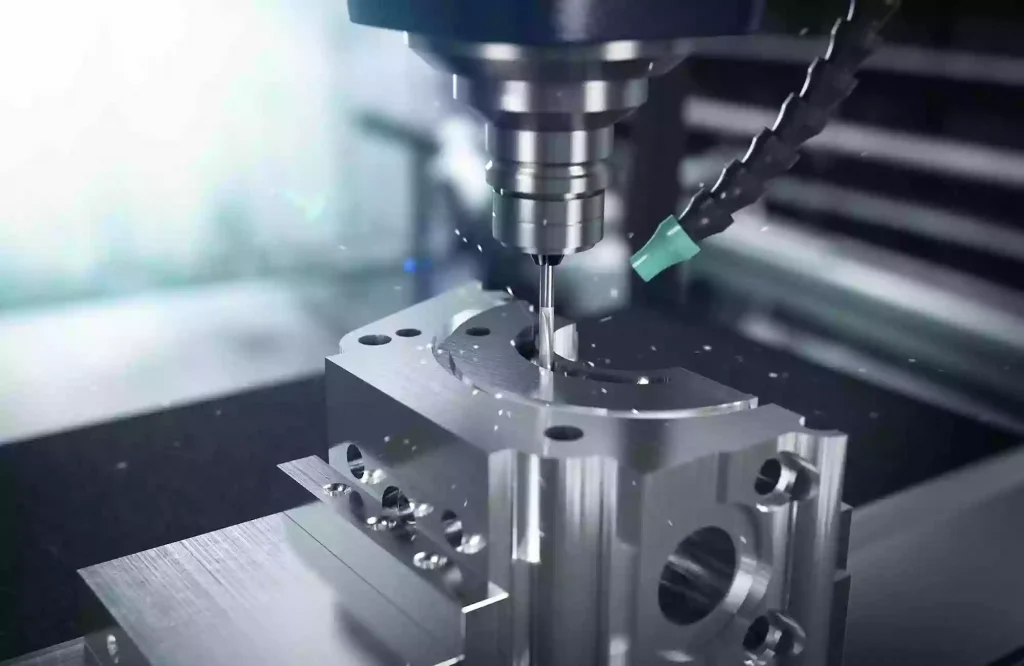
In the manufacturing world, 3-axis machining (X, Y, and Z linear axes) is the baseline standard for most machine shops. While it works perfectly for flat parts or simple geometries, it hits a wall when dealing with complex designs—such as angled holes, multi-sided components, or contoured surfaces.
With a 3-axis setup, machining these features requires frequent repositioning, designing custom fixtures, and running multiple setups. This not only consumes valuable time but also introduces alignment errors every time the part is flipped, which compromises the final accuracy.
The development of 5-axis machining directly addresses this bottleneck. The goal is simple: to complete the machining of complex, multi-sided parts in a single setup.
How Do the Rotary Axes Move in 5-Axis Machining?
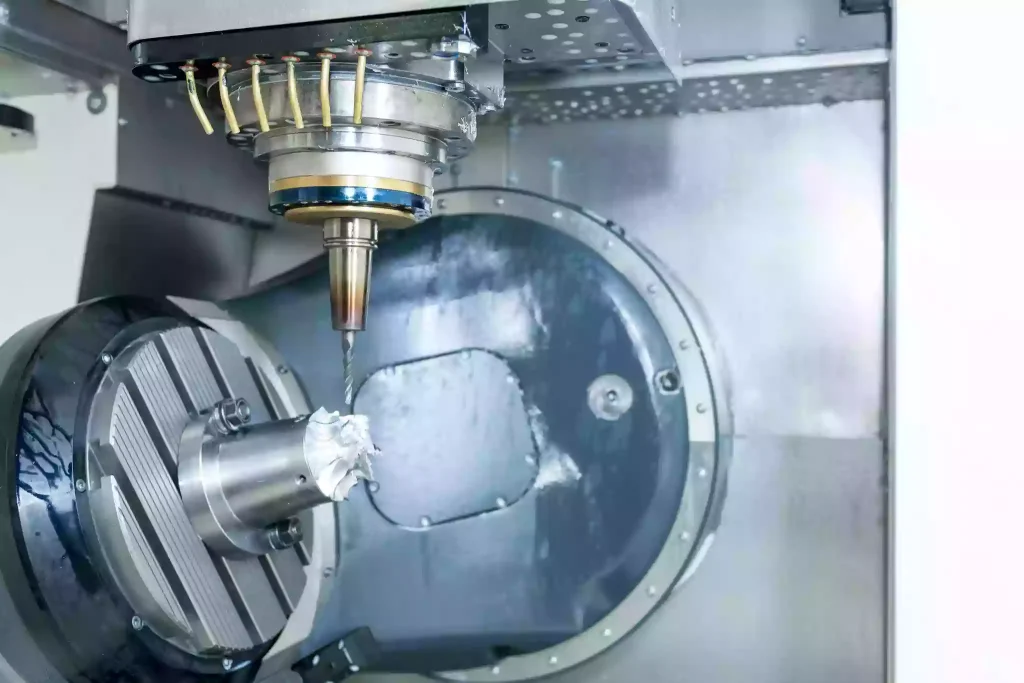
To understand 5-axis machining, it helps to look at how the machine moves in 3D space. In addition to the standard linear axes—X (left/right), Y (forward/backward), and Z (up/down)—a 5-axis machine introduces two rotational axes.
According to international machining standards, these rotational axes are defined by which linear axis they rotate around:
- A-axis: Rotates around the X-axis.
- B-axis: Rotates around the Y-axis.
- C-axis: Rotates around the Z-axis.
A 5-axis machine does not use all three rotational axes at once; that would make it a 6-axis machine. In three-dimensional space, 5 degrees of freedom are mathematically sufficient to orient a cutting tool at any given angle relative to the workpiece. Therefore, a 5-axis machine pairs the three linear axes (X, Y, Z) with a choice of two rotary axes—typically AC or BC combinations.
The Three Common Mechanical Configurations
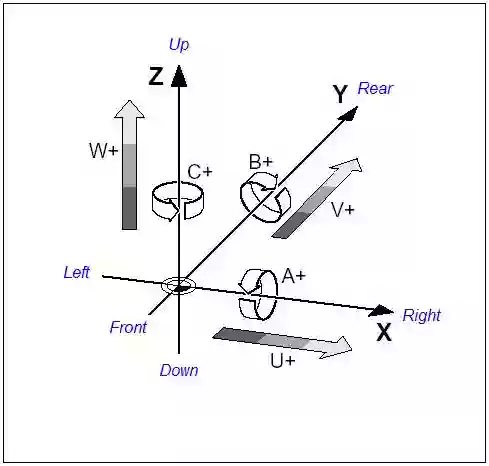
Where these two rotary axes are physically integrated into the machine determines its configuration. There are three primary designs used in the industry, and each is suited for specific types of work.
Trunnion / Table-Table Type
In a trunnion-style machine, the spindle head remains stationary in its rotational plane, and both rotary axes (such as A and C) are built into the worktable itself. The table tilts and rotates to position the part.
- Advantages: Because the spindle does not tilt, it offers excellent mechanical rigidity, making it well-suited for heavy material removal. The table-table design also provides a wide range of tilt angles, which is highly beneficial for machining deep pockets or complex multi-sided parts.
- Limitations: Since the entire table and the workpiece must tilt and rotate together, the weight of the part heavily loads the drive motors. For this reason, trunnion machines are generally restricted to smaller, lighter, high-precision components.
Swivel Head / Head-Head Type
In this configuration, the worktable remains completely stationary, and both rotary axes are located in the spindle head. The spindle tilts and swivels around the stationary workpiece.
- Advantages: The worktable can be much larger and support significantly heavier loads. As long as the part fits within the machine enclosure, the spindle head can maneuver around it. This makes it the industry standard for large aerospace components, such as aircraft wing spars or large structural bulkheads.
- Limitations: The mechanical design required to fit two rotary axes inside a moving spindle head is complex. This inherently reduces the structural rigidity compared to a fixed spindle, making head-head machines more prone to vibration during heavy, high-volume roughing cuts in hard metals.
Hybrid / Head-Table Type
The hybrid configuration splits the work. The spindle head handles one rotary axis (such as the B-axis), while the worktable handles the other (such as the C-axis).
- Advantages: This design balances the pros and cons of the other two types. The table only rotates horizontally, allowing it to carry heavier parts than a trunnion machine. Meanwhile, the spindle head only swivels in one direction, retaining higher rigidity than a dual-rotary spindle head.
- Limitations: Because the rotational movement is split between the tool and the part, certain extreme machining angles can cause clearance issues. Programmers and operators must pay closer attention to potential interferences between the tool holder and the table setup.
Simultaneous 5-Axis vs. 3+2 Axis Machining
When evaluating 5-axis capabilities, you will frequently encounter two terms: Simultaneous 5-Axis Machining and 3+2 Axis Machining (often called positional or indexed 5-axis). While both types of machines utilize five axes, the way they move during the cutting process is fundamentally different.
What is 3+2 Axis (Positional) Machining?
In a 3+2 axis setup, the machine uses its two rotary axes to tilt the workpiece or the spindle head to a specific angle, locks those axes in place, and then executes standard 3-axis (X, Y, Z) cutting. The rotary axes do not move while the cutting tool is engaging the material. If the tool needs to cut another face of the part, the machine stops cutting, unlocks the rotary axes, repositions to the new angle, locks again, and resumes 3-axis machining.
- The Main Benefit: It is primarily an efficiency tool for multi-sided parts. Instead of designing five different fixtures to machine five sides of a cube on a standard 3-axis machine, a 3+2 setup allows you to complete the work in a single setup, saving significant fixture costs and operator time.
- The Limitation: It cannot machine complex, continuously sweeping organic shapes. It only cuts flat planes, straight pockets, or angled holes that line up with the locked tool orientation.
What is Simultaneous 5-Axis Machining?
In simultaneous 5-axis machining, all five axes—the three linear axes ($X, Y, Z$) and the two rotary axes—move continuously and dynamically at the same time while the tool is cutting material. As the spindle travels along a contour, the table or the head actively swivels to maintain a specific relationship between the cutting tool and the part surface.
To make simultaneous 5-axis machining precise, machines rely on a core technology known as RTCP (Rotational Tool Center Point control), sometimes called TCPM (Tool Center Point Management) depending on the CNC control system (such as Heidenhain, Siemens, or Fanuc).
The Role of RTCP
Without RTCP, if you rotate a machine’s rotary axis by $1^\circ$, the physical position of the cutting tool tip shifts drastically in space because it moves along an arc. The programmer would have to calculate this exact spatial shift for every single movement within the CAM software, which is nearly impossible to do accurately for dynamic paths.
With RTCP activated, the CNC controller automatically calculates the real-time pivot distance of the machine. When a rotary axis turns, the controller instantly commands the linear axes ($X, Y, Z$) to compensate for that rotation. As a result, the tool tip stays exactly where it needs to be relative to the part surface, regardless of how the machine structure is tilting. Without robust RTCP control, true simultaneous 5-axis machining cannot function effectively.
How to Choose: Simultaneous vs. 3+2
| Feature / Factor | 3+2 Axis (Positional) | Simultaneous 5-Axis |
| Movement State | Rotary axes are locked during cutting. | All 5 axes move dynamically during cutting. |
| Best Suited For | Prismatic parts with angled faces, deep pockets, or tilted tapped holes. | Impellers, turbine blades, complex molds, and organic or biomimetic surfaces. |
| Programming | Relatively straightforward; similar to standard 3-axis programming. | High complexity; requires specialized CAM software and collision verification. |
| Tooling Choice | Allows the use of shorter, rigid tools for deep pockets by tilting the part. | Requires constant tracking of the tool flank or tip contact point. |
| Cost & ROI | Lower software and machine costs; highly cost-effective for general job shops. | Higher initial investment, but necessary for advanced, complex geometries. |
As a general rule, if your part consists of flat faces that sit at odd angles, or features that can be reached by simply tilting the tool once, 3+2 axis is usually the more practical and economical choice. If your part features continuous, free-form curves where the tool must constantly adjust its angle to remain perpendicular to the surface—such as an aerospace impeller—simultaneous 5-axis is mandatory.
The Economic Model of 5-Axis Machining (ROI)
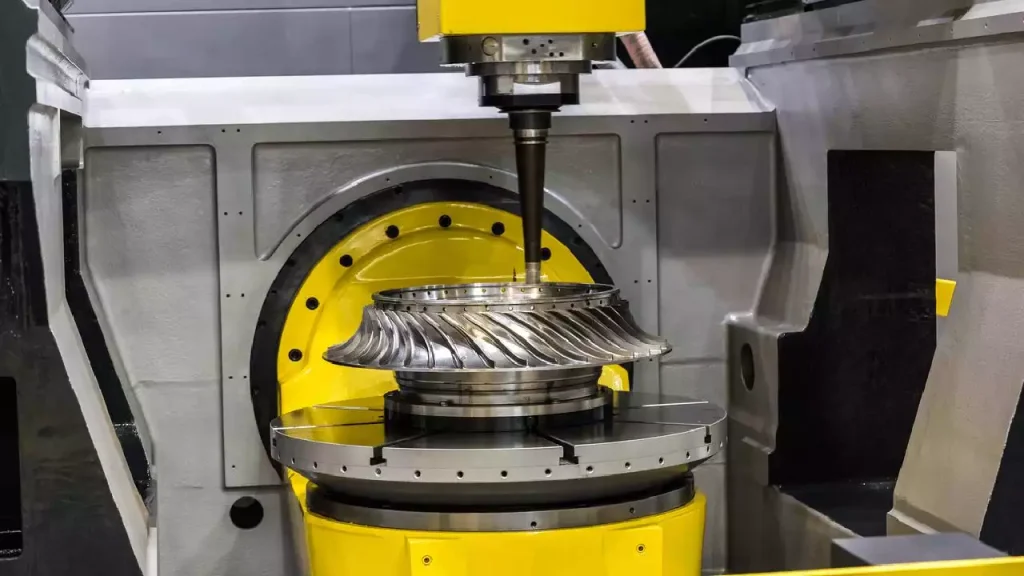
When shops hesitate to adopt 5-axis machining, the primary barrier is almost always the initial purchase price of the machine and software. However, looking only at the upfront equipment cost overlooks the operational expenses that occur throughout a project’s lifecycle.
Reduction in Fixturing Costs and Setup Times
In a traditional 3-axis workflow, machining a complex, multi-sided part requires a series of operations. Each operation requires its own fixture to hold the part securely at a specific orientation.
- The 3-Axis Expense: For a complex six-sided part, you might need four to five distinct fixtures. Designing, machining, and verifying these fixtures requires significant engineering hours and material costs. Furthermore, every time an operator manually unclamps a part, cleans the chips, and clamps it into the next fixture, production stops. This introduces a risk of part-to-part variation due to manual alignment errors.
- The 5-Axis Alternative: A 5-axis machine uses a “Done-in-One” or single-setup approach. By utilizing a standard self-centering vise or a zero-point clamping system, the machine can access five sides of the part in a single clamping cycle. You eliminate the labor costs of building multiple fixtures and drastically reduce the non-cutting idle time spent on setups.
Tool Life and Surface Finish Optimization
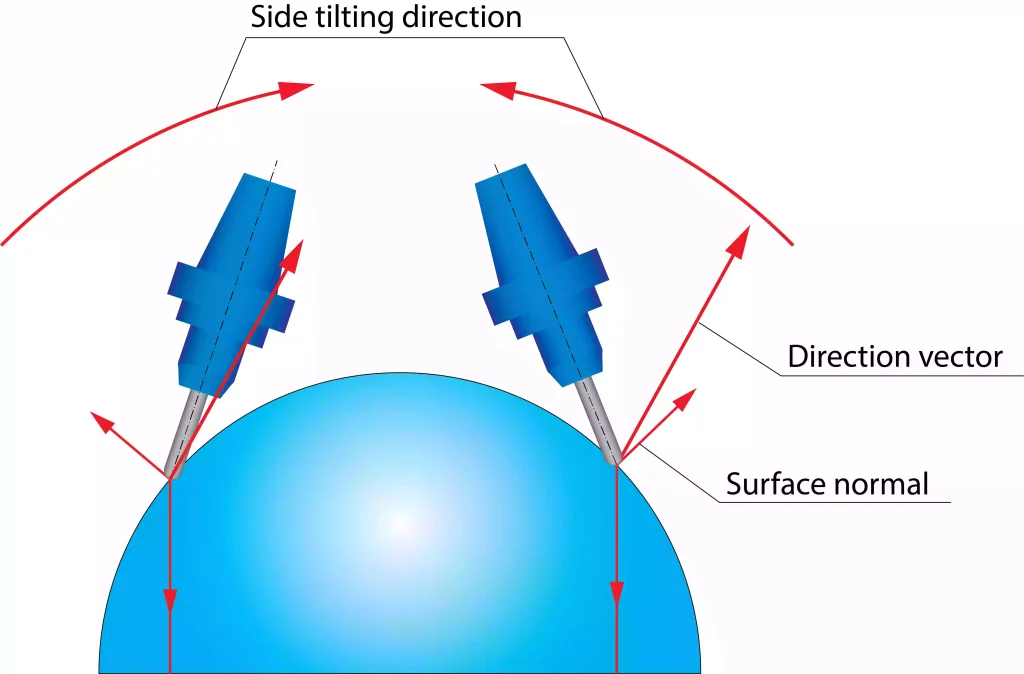
The physics of how a CNC tool cuts material has a major impact on tool wear and manual post-processing labor. When a standard 3-axis machine uses a ball-nose end mill to clear a flat, shallow pocket or a gentle slope, the very center tip of the tool is forced to do the cutting. Because the rotational radius at the exact center tip of a tool is zero, the actual cutting speed ($V_c$) drops to zero. Instead of cleanly shearing the metal, the tool tip drags and pushes the material, leading to rapid tool wear and a poor, rough surface finish.
3-Axis Machining: Tool tip cuts at 0 speed -> Drags material -> High wear, rough finish
5-Axis Machining: Tool tilts at an angle -> Cuts at optimal edge speed -> Clean shear, smooth finish
A 5-axis machine resolves this through tilt-angle optimization. By tilting either the table or the spindle head, the machine ensures that the cutting action occurs on the flank or the radius of the tool, rather than the dead center. This offers two direct financial benefits:
- Extended Tool Life: The cutting forces are distributed evenly across a sharper, faster-moving section of the carbide, frequently extending tool life by 30% or more.
- Elimination of Hand Polishing: The surface roughness ($Ra$) is significantly improved straight out of the machine. For mold-making shops or medical device components, this can entirely eliminate hours of manual hand-polishing and benchwork, which is often one of the most expensive labor components in a shop.
Impact on Total Lead Time
In manufacturing, lead time directly influences cash flow. In a multi-setup 3-axis environment, a batch of parts often sits in queues between different machines or setups, waiting for fixtures to be changed or operators to become available. A job that requires two hours of total cutting time can easily take five to seven days to move through the shop floor.
By condensing multiple operations into a single setup on a 5-axis machine, the part remains on the machine from raw stock to near-completion. This streamlines shop floor logistics, reduces work-in-progress (WIP) inventory, and allows shops to compress a one-week lead time down to 24 to 48 hours. For high-mix, low-volume job shops, this agility is often the deciding factor in winning premium-rate contracts.
Real-World Operational Challenges: Managing the Risks
While the benefits of 5-axis machining are clear, implementing the technology successfully requires a realistic understanding of its operational challenges. Many shops treat a 5-axis machine simply as an expensive 3-axis machine, only to face high maintenance costs, programming bottlenecks, or unexpected downtime.
The Cost and Consequence of a Collision (Machine Crashes)
In a standard 3-axis machine, the cutting tool moves along linear planes. If an error occurs in the programming, the tool typically moves straight into the workpiece or a vise. While this causes damage, the impact is usually contained to a broken tool, a ruined part, or at worst, a localized realignment of the spindle.
In a 5-axis machine, the linear axes (X, Y, Z) and rotary axes move simultaneously and at high speeds. Because the machine structure or the table is tilting dynamically, a programming error can cause the heavy spindle housing to collide directly with the machine’s rotary table or workholding equipment. Due to the leverage exerted by long tool holders and the mass of the moving components, a 5-axis collision can easily deform the internal guideways, destroy the precision bearings, or crack the spindle housing. Repairing a high-speed 5-axis spindle and recalibrating the machine’s geometry can cost tens of thousands of dollars and result in weeks of lost production capacity.
The CAM Post-Processor Bottleneck
A common misconception is that buying advanced CAM software is enough to generate 5-axis toolpaths. In reality, the toolpaths generated inside the CAM software are generic vector movements. For the machine to execute these movements, they must be converted into specific G-code via a software script called a Post-Processor.
Every 5-axis machine model, CNC controller type (e.g., Siemens 840D, Heidenhain TNC 640, or Fanuc 31i), and internal pivot distance configuration requires a custom-built post-processor. If the post-processor is poorly calibrated, the machine may hesitate between blocks of code, fail to execute RTCP functions correctly, or output erratic rotary movements that leave visible dwell marks on the part surface. Developing, testing, and fine-tuning a reliable 5-axis post-processor requires specialized software engineering and extensive trial cuts in soft materials.
The Necessity of Dedicated G-Code Simulation
Because of the high risk of collisions and the complexity of multi-axis motion, shops cannot rely solely on the internal simulation provided by standard CAM software. Internal CAM verification typically only checks the tool and the part geometry; it often fails to accurately simulate the physical sheet metal housing of the machine, the workholding fixtures, or the real-world deceleration of the machine axes.
Generic CAM Toolpath -> Custom Post-Processor -> Third-Party G-Code Simulation (Vericut) -> Safe Machine Execution
To operate safely, 5-axis shops must implement independent, G-code-based simulation software, such as CGTech Vericut. These programs read the exact G-code file intended for the machine controller and simulate the entire physical environment of the machine tool in digital space. This step catches hidden tool-holder interferences, over-travel limits, and axis reversals before the file ever reaches the shop floor. This adds an extra layer of software cost and preparation time to every job.
Thermal Deformation and Kinematic Calibration
With five axes of motion, minor geometric errors are amplified across the length of the cutting tool. During extended machining cycles, the high-speed spindle and the friction in the rotary axis drive motors generate heat. This heat causes localized thermal expansion of the machine components. In a 3-axis machine, thermal growth along the Z-axis is relatively easy to monitor and compensate for. In a 5-axis machine, thermal expansion changes the center of rotation of the rotary axes relative to the spindle nose.
An error of just 10 microns (0.01 mm) at the center of a rotary table can translate into a significant dimensional deviation on the finished part when the table tilts $90^\circ$. To combat this, shops must perform regular kinematic calibrations using precision calibration spheres and specialized probing cycles (such as Heidenhain’s KinematicsOpt or Siemens’ Cycle996) to map out and compensate for these micro-geometric shifts on a weekly or even daily basis.
Advanced Trends: The Changing Technical Landscape
The operational standards for 5-axis machining continue to shift as software, automation, and alternative manufacturing methods mature. Modern machine shops are no longer treating the 5-axis mill as a standalone cutting tool; instead, they are integrating it into interconnected production ecosystems.
Hybrid Machining: Integrating Additive and Subtractive Processes
One of the most notable developments in high-end manufacturing is the combination of metal 3D printing (additive manufacturing) and 5-axis CNC milling within a single machine tool chamber. This approach typically pairs Direct Energy Deposition (DED) laser systems with a continuous 5-axis machining platform.
- How It Operates: The machine uses the additive nozzle to build up a near-net-shape component layer by layer, or to deposit high-value material onto an existing base structure. Immediately afterward, the 5-axis milling spindle engages to finish-machine critical internal cavities, mating faces, or tight-tolerance features that would be inaccessible after the part is fully built.
- The Practical Benefit: This hybrid approach drastically reduces material waste when working with expensive superalloys like Inconel or Titanium. It also allows aerospace and medical manufacturers to produce complex internal cooling channels and hollow structures that cannot be made by conventional machining alone.
Adaptive Control and Real-Time Force Monitoring
Traditional 5-axis programming relies on static feed rates and cutting speeds calculated during the CAM programming stage. However, real-world conditions vary due to material hardness inconsistencies, tool wear, and fluctuating tool engagement angles as the machine swivels.
To address this, modern 5-axis controllers utilize adaptive control algorithms paired with sensors embedded directly in the spindle and axis drives.
- Dynamic Adjustments: If the cutting tool encounters a heavier cross-section of material or begins to vibrate as it enters a deep pocket, the controller monitors the spike in spindle motor current and automatically reduces the feed rate within milliseconds.
- Preventing Tool Failure: Conversely, when tool engagement decreases, the system accelerates the feed rate to maintain a constant chip load. This real-time optimization maximizes the Material Removal Rate (MRR), prevents sudden tool breakage, and protects the high-cost 5-axis spindle from sustained harmonic vibration.
Automation, Zero-Point Systems, and Robotic Cells
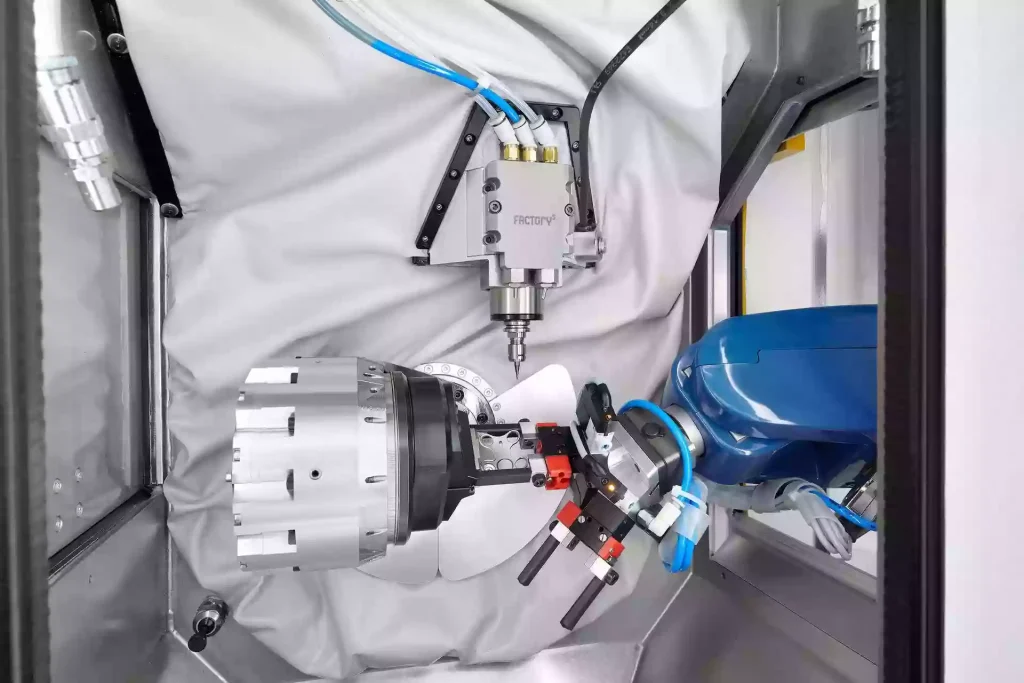
To justify the high capital expenditure of a 5-axis machine, shops must maximize spindle utilization hours, aiming for continuous operation across multiple shifts. This has driven the widespread adoption of automated flexible manufacturing cells (FMC).
[Robotic Arm] —> [Pneumatic Zero-Point Chuck] —> [5-Axis Machine Runs Unattended]
- The Role of Zero-Point Clamping: Rather than manually clamping parts into a vise inside the machine, parts are pre-loaded onto standardized pallets outside the machine enclosure. These pallets interface with pneumatic or hydraulic zero-point clamping receivers installed on the 5-axis rotary table, ensuring a repeatable positioning accuracy within less than 5 microns (0.005 mm).
- Unattended “Lights-Out” Production: By pairing a 5-axis machine with an industrial robot arm and a multi-station pallet pool, the machine can run completely unattended through the night. The robot automatically swaps out completed parts for fresh raw blanks, allowing shops to sustain high-volume output without adding manual labor costs.
Supply Chain Modernization: How Xtmade Simplifies Access to 5-Axis Manufacturing
For many engineering teams and hardware developers, utilizing 5-axis machining has historically meant navigating a highly fragmented and technically restrictive supply chain. The operational challenges—ranging from steep machinery costs to the specialized programming expertise required—often prevent smaller enterprises or rapid-turnaround projects from leveraging high-end manufacturing.
Digital manufacturing platforms like Xtmade alter this dynamic by decoupling advanced 5-axis capabilities from the traditional limitations of local machine shops.
Replacing the “Quoting Black Box” with Automated Analysis
In a conventional procurement model, securing a quote for a 5-axis machined component is a slow, manual process. A shop’s internal estimating engineer must manually review the 3D model, evaluate the complex setups required, calculate tool paths, and assess potential collision risks. For low-volume orders or highly complex parts, this quoting bottleneck can take anywhere from three to five business days.
Xtmade replaces this manual evaluation with an automated digital interface. When an engineer uploads a 3D CAD model (such as a STEP or IGS file), the platform’s geometry-parsing algorithms instantly analyze the part’s spatial features. The system identifies which faces can be reached via 3+2 positioning and which require continuous 5-axis motion, generating a comprehensive cost analysis and a production quote within minutes rather than days.
Leveraging a Scalable Network of Specialized 5-Axis Assets
Investing millions of dollars into premium 5-axis machine tools—such as DMG MORI, Mikron, or Okuma platforms—is financially unfeasible for many product development teams. At the same time, relying on a single local vendor exposes a project to capacity bottlenecks if that vendor’s machines are booked with long-term aerospace or automotive contracts.
Xtmade addresses this through a vetted, digitized network of manufacturing facilities. By aggregating capacity across multiple specialized facilities, the platform matches your project’s specific requirements (such as machining titanium impellers or high-hardness tool steel molds) with a machine tool that has the exact required kinematic configuration and an open production slot. This distributed manufacturing approach mitigates supply chain disruptions and typically reduces overall lead times by up to 40%.
[User Uploads CAD] -> [Xtmade Algorithmic Check] -> [Optimal 5-Axis Shop & Machine Matched] -> [Production Begins]
Automated Design for Manufacturability (DFM) Feedback
As detailed in previous sections, the risk of tool interference or machine collision during 5-axis motion is exceptionally high. Discovering that a tool cannot reach a deep, narrow pocket at a specific tilt angle after the machine has been set up results in costly scrap and project delays.
The Xtmade platform integrates automated DFM analysis directly into the upfront interface. The software scans the digital geometry for common 5-axis failure modes, such as:
- Inadequate clearance for standard tool holders during tight angular rotations.
- Unusually deep cavities that would require fragile, non-standard tool lengths.
- Inconsistent datum surfaces that complicate one-step clamping setups.
By flagging these manufacturing constraints before a single chip is cut, engineers can adjust their designs early, removing the risk of machine crashes and ensuring a predictable production cycle.
End-to-End Data Transparency
Traditional manufacturing outsourcing often leaves buyers in the dark regarding the actual status of their components. Xtmade establishes a transparent tracking system that follows the part through its entire lifecycle.
Because the platform integrates directly with the production workflow of its network partners, users receive real-time data milestones—from raw material sourcing and 5-axis CAM programming verification to final cnc machining and coordinate measuring machine (CMM) quality inspection reports. This level of digital visibility ensures that complex components meet rigorous aerospace, medical, or industrial tolerances before they are packed and shipped.
Practical Guide: Designing and Sourcing for 5-Axis CNC Machining
Successfully leveraging 5-axis machining requires more than just uploading a file to a digital platform or sending it to a shop floor. Engineers must design components with a clear understanding of the physical limitations of multi-axis cutting tools. Proper material selection, geometric planning, and vendor verification are essential to control production costs and prevent manufacturing failures.
Machining Dynamics of Advanced Materials
5-axis machines are frequently utilized for high-performance components made from difficult-to-cut materials. Understanding how these materials behave under multi-axis toolpaths is critical for predicting part quality and cycle times.
- Titanium Superalloys (e.g., Ti-6Al-4V): Widely used in aerospace and medical implants, titanium has low thermal conductivity. During 5-axis machining, heat does not dissipate with the chips; instead, it concentrates at the tool edge. Continuous 5-axis paths must maintain constant tool engagement and employ high-pressure coolant to prevent rapid tool degradation.
- Nickel-Based Superalloys (e.g., Inconel 718): These materials work-harden rapidly during cutting. If a continuous 5-axis toolpath slows down or hesitates during a complex angular transition, the material will harden, causing immediate tool breakage. High-rigidity machine setups and aggressive, uniform chip loads are mandatory.
- High-Hardness Die Steels (e.g., H13, D2): Commonly used for injection molds. Utilizing 3+2 or continuous 5-axis machining allows shorter, rigid tool assemblies to cut deep cavities directly into hardened steel, minimizing electrical discharge machining (EDM) operations.
DFM Golden Rules for 5-Axis Geometries
To ensure a part can be produced efficiently on a 5-axis machine, keep these fundamental Design for Manufacturability (DFM) rules in mind during the CAD modeling phase:
[Tool Holder Clearance] ──> Ensure a minimum 15° to 20° draft angle in deep cavities.
[Workholding Datums] ──> Include a flat, uniform base section for secure single-clamp holding.
- Prioritize Tool Holder Clearance: As the machine table or spindle head swivels, the thick upper body of the tool holder moves close to the part. Always design deep cavities or steep walls with sufficient draft angles (typically $15^\circ$ to $20^\circ$ depending on the depth) to allow the tool to tilt without the holder colliding with the upper edges of the component.
- Design for Single-Setup Workholding: The financial advantage of 5-axis machining relies on holding the part once. Ensure your design includes a reliable clamping feature—such as a uniform square base or sacrificial material extension—that a self-centering vise or zero-point fixture can grip securely while leaving the remaining five faces fully accessible to the spindle.
- Avoid Excessively Small Internal Radii: Continuous 5-axis movement requires fluid, sweeping tool motions. Sharp internal corners force the machine’s rotary axes to decelerate rapidly to change direction, creating surface blemishes and increasing cycle times. Use generous corner radii to allow the machine to maintain a constant feed rate.
Supplier Verification: Identifying Real 5-Axis Capabilities
If you choose to source your parts through traditional vendor channels rather than an integrated digital network, you must audit the supplier’s technical depth. Many shops market themselves as “5-axis capable” when their operational reality is limited.
When vetting a supplier, ask these three technical questions:
1.“Does your 5-axis equipment support hardware-level RTCP (or TCPM), or do you rely entirely on CAM-programmed vector translation?” If they do not use active RTCP on the machine controller, they cannot efficiently or accurately run complex, continuous 5-axis toolpaths.
2.“What software do you use for post-processing and G-code simulation?” A qualified 5-axis shop should immediately name independent validation software like Vericut. If they rely solely on the operator “dry-running” the program over the air, the risk of machine collisions and delayed deliveries is exceptionally high.
3.“How do you calibrate your machine’s rotary axis kinematics, and how frequently?” Reliable facilities track thermal movement and mechanical drift by performing automated probing routines on calibration spheres at least once a week to ensure micro-geometric precision.
Alternatively, utilizing an audited digital manufacturing platform like Xtmade bypasses this manual vetting process entirely, as all network assets are pre-screened and managed under a unified digital quality management system.
Adapting to High-Dimensional Manufacturing
5-axis CNC machining is no longer a niche capability reserved exclusively for tier-one aerospace contractors. As component geometries become more complex and product development cycles compress, the ability to eliminate multiple setups and achieve superior surface finishes straight out of the machine has become a baseline requirement for maintaining market competitiveness.
Succeeding with this technology requires a balanced approach that combines smart, multi-axis Design for Manufacturability (DFM) with an agile, reliable supply chain. For modern engineering teams, the goal is no longer about learning how to operate these complex machines internally, but rather knowing how to efficiently deploy 5-axis capability when a project demands it. Digital manufacturing ecosystems like Xtmade bridge this gap, allowing hardware innovators to leverage premium, multi-axis production assets seamlessly, predictably, and without capital constraints.