
CNC Machining Lead Times: How long CNC machining actually takes and how to shorten delivery times
When inquiring about CNC machining services, clients most frequently ask not whether a part can be made, but rather how long delivery will take.A common misconception in the industry is that CNC machining simply involves loading a program into the machine to generate parts quickly, or that the lead time is equivalent to the machine’s actual cutting time. In reality, the process from uploading a drawing to receiving the finished part encompasses multiple stages—including engineering assessment, material preparation, programming, workholding setup, machining, quality inspection, surface finishing, and shipping. What truly determines delivery speed is often not the machine’s runtime, but the efficiency and coordination of the entire manufacturing workflow.
A three-day delay on a single part can derail the critical path for testing, assembly, or client approval, thereby impacting prototyping schedules, procurement risks, and product launch dates. Consequently, extended lead times rarely stem from a single bottleneck; rather, they result from the cumulative effect of numerous “small decisions” made prior to the spindle even beginning to cut. For engineers and procurement teams, understanding the components, typical ranges, and key drivers of CNC machining lead times not only facilitates more accurate project scheduling but also enables more rational decision-making regarding the balance of cost, quality, and delivery speed.
Why CNC Machining Lead Times Are So Important?
Accurately measuring CNC machining hours and overall delivery cycles is not merely a key link in manufacturing management; it is a strategic core for modern industrial enterprises seeking to optimize operations and honor customer commitments. First, it serves as the foundation for precise cost control; by gaining insight into the actual time consumed by each process, enterprises can comprehensively manage multi-dimensional costs ranging from materials and labor to energy and tooling. Second, accurate time data is a prerequisite for scientific production scheduling and efficient resource coordination; it effectively eliminates shop-floor bottlenecks and enables the dynamic, optimized allocation of machinery and technical personnel. Most importantly, rational cycle planning avoids the pitfalls of rushed production, allowing sufficient time for quality inspections and thereby fortifying the defense against quality issues. Ultimately, the delivery certainty derived from data not only translates into customer satisfaction that surpasses the competition but also aligns perfectly with modern just-in-time production models; by accelerating logistics flows, it enables the entire supply chain to achieve superior operational efficiency.
What stages are actually included in the CNC machining delivery cycle?
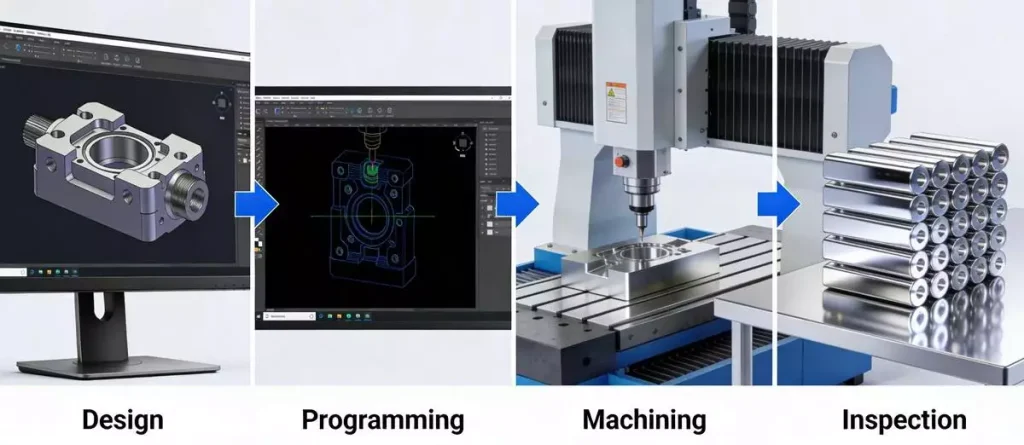
Many buyers often mistake “lead time” for simply the “machine cutting time.” In reality, a complete delivery cycle consists of the following sequential stages, each of which is indispensable:
- Quotation and Engineering Review (DFM): The technical team reviews drawings and specifications, identifies manufacturing challenges, and clarifies ambiguous requirements (2–5 days for standard parts; 1–2 weeks for complex parts).
- Material Procurement and Certification:Purchasing raw materials. Standard materials take a few days, while special alloys or aerospace/medical-grade materials require 2–8 weeks; Material Test Reports (MTRs) must also be collected and verified.
- Job Scheduling and Capacity Planning: Orders are queued for the shop floor. Scheduling is based on deadlines, complexity, and current plant capacity; high workloads or urgent “rush-in” orders can significantly extend wait times.
- Tooling Development and Machine Setup:Pre-production preparation. This includes the design and manufacture of custom fixtures (1–4 weeks), mounting tools, loading programs, and producing/inspecting the first article; multiple setups can exponentially increase the time required.
- Manufacturing Operations (Actual Cutting): The time the machine is actively cutting metal. Factors include geometry, material hardness (titanium is slower than aluminum), and tolerance strictness; high-volume production can improve per-unit efficiency through the “learning effect.”
- Inspection and Quality Verification: Dimensional and surface quality checks. CMM or optical measurement is used for first-article or full inspection; if non-conforming parts are found, rework or scrapping and restarting can cause the delivery schedule to spiral out of control.
- Finishing and Secondary Processing (Outsourced):Surface treatments such as anodizing, heat treatment, and plating. These usually require sending parts to specialized external vendors; heat treatment alone can add 5–10 days to the lead time.
- Documentation and Final Shipping: Administrative and logistical delivery. Especially in the medical and aerospace sectors, compiling compliance inspection reports and traceability documentation takes several days, followed finally by packaging and shipment.
The CNC manufacturing cycle is not merely the time spent cutting metal; it is a comprehensive process comprising multiple sequential steps. Understanding these stages helps customers better plan their projects and identify key areas for optimization when expedited delivery is required.
How long does CNC machining usually take? Reference for typical lead times.
Before analyzing specific engineering variables, buyers need to establish a realistic baseline. In the CNC industry, standard turnarounds are directly determined by order volume and part complexity.
1. Industry Baseline Lead Times
To facilitate quick assessment during early-stage planning, production runs are categorized into five volume tiers. Assuming complete CAD data and available material, the standard and expedited timelines are as follows:
| Order Volume & Part Type | Standard Lead Time | Expedited Lead Time |
| 1-5 Pcs (Simple Prototype) | 3 – 5 Days | 1 – 3 Days |
| 1-5 Pcs (Complex Prototype) | 7 – 10 Days | 3 – 5 Days |
| 10-50 Pcs (Low Volume) | 7 – 14 Days | 7 – 10 Days |
| 50-500 Pcs (Mid Volume) | 21 – 28 Days | 14 – 21 Days |
| 500+ Pcs (High Volume) | 28 – 42 Days | 21 – 28 Days |
2. Post-Processing & Complexity Variables
Note that the table above reflects only the basic machining time for raw parts. In actual manufacturing, specific part features and secondary operations will create cumulative delays that must be factored into your schedule:
- Standard Low-Volume Parts: Base timeline of 1–3 weeks.
- Complex Precision Parts: Base timeline of 2–5 weeks (e.g., tough materials like Titanium or Inconel machine much slower than Aluminum).
- Surface Finishing: Add 3–10 days to the base lead time (accounts for anodizing, plating, or painting transit and queuing at outsource vendors).
- Heat Treatment: Add 1–2 weeks (covers multi-point logistics, vendor scheduling, and return shipping).
- Full Inspection Reports: Add a few days (includes dedicated CMM measuring, optical comparison, or compliance documentation).
3. The Consequences of Underestimating Lead Times
Misjudging CNC lead times often triggers a domino effect across the entire project. Failing to account for material procurement, quality paperwork, or secondary operations typically results in:
- Delayed Design Verification: Prototypes fail to arrive on time, pushing back testing, validation, and subsequent design iterations.
- Disrupted Assembly Schedules: When critical low-volume parts are late, final assembly lines grind to a halt waiting for a single component.
- Inventory and Sourcing Imbalances: Delays in repeat orders trigger stock shortages, forcing buyers into a costly cycle of last-minute rush orders.
- Higher Coordination Costs: Delivery errors require project managers to waste administrative effort renegotiating materials, changing shipping methods, and reshuffling priorities.
Key Factors Affecting CNC Machining Lead Times
CNC machining lead time is a complex system driven by multiple coordinating variables. When two suppliers provide significantly different lead times, it is usually because the following core drivers are at play:
1. Part Geometry and Complexity
Part geometry is the single biggest variable determining machining hours. Prismatic parts with large openings, standard hole sizes, and moderate tolerances can be machined very quickly. Conversely, parts with deep cavities, thin walls, undercuts, or multi-faceted features require exponentially more setup and machining time due to intensive CAM programming, complex fixturing, and increased inspection points.
2. Tolerance Requirements
The strictness of tolerances directly dictates the margin for error in the manufacturing window. For non-critical features, maintaining a tolerance of ±0.1 mm is standard practice, allowing for high-speed cutting and rapid spot checks. However, when multiple critical features demand tolerances of ±0.1 mm or tighter, the machine must run at lower cutting speeds. Operators must also halt production frequently for tool wear compensation and rigorous inspection (such as CMM testing), which drastically extends the lead time.
3. Material Properties and Availability
Raw material characteristics not only dictate cutting efficiency but are also tied to supply chain constraints. Aluminum and engineering plastics offer shorter lead times because they are highly machinable and readily available. In contrast, stainless steel, titanium, hardened steel, and superalloys require longer machining times and accelerate tool wear. Furthermore, if a project requires specific grades, non-standard sizes, or aerospace-grade specialty materials, simply waiting for material procurement and verifying Mill Test Certificates (MTC) can add 2 to 8 weeks to the timeline.
4. Specialized Cutting Tools
If a part design includes highly specialized structures—such as extremely small, deep internal channels—the machine shop’s existing standard inventory won’t cut it. This demand for non-standard tooling means the shop must spend time sourcing or custom-ordering extended cutting tools before production can even begin, a delay that is tacked directly onto the overall lead time.
5. Surface Finishing and Secondary Operations
Secondary operations are often outsourced to specialized external vendors and are a primary source of hidden delays. Processes like anodizing, plating, passivation, bead blasting, or laser engraving mean that even after machining is complete, the delivery date hinges on the external shop’s queue, typically adding 3 to 10 days. Heat treatment processes can easily force an extra 1 to 2 weeks onto the lead time due to multi-point transit, vendor scheduling, and incoming quality control inspections upon return.
6. Order Volume and Shop Capacity
Production volume has a massive impact on timelines. While prototype runs (1–5 pieces) are small, new parts often require multiple process iterations to dial in the required tolerances. Large-scale orders amortize setup times over more parts, but they require heavier upfront investments in tooling planning, tool-life management, and First Article Inspection (FAI). Additionally, if a supplier’s shop floor is at maximum capacity or disrupted by expedited orders, the queue time before a project even hits the machine will be stretched.
In practice, the completeness of engineering drawings is just as critical to the lead time. If a drawing lacks information, leaves materials ambiguous, or fails to specify tolerances, the supplier must spend time in back-and-forth technical alignment with the buyer, causing massive delays before production ever kicks off. For precision components, building a long-term partnership with a mature supplier—leveraging pre-verified programs and dedicated fixturing—remains the single best strategy to compress lead times on repeat orders.
How to Shorten CNC Machining Cycles Without Compromising Quality
The key to compressing CNC lead times lies in eliminating ambiguities and reducing non-machining hours. Here are four actionable strategies to accelerate delivery:

Optimize Design at the Source (Advanced DFM)
Part geometry directly dictates spindle time. Implement these principles during the design phase:
- Reduce Machining Faces: Concentrate features on as few sides as possible. For multi-faceted parts, leverage 5-axis machining to allow single-setup production and eliminate manual re-fixturing.
- Limit Aspect Ratios: Avoid designing cavities or holes with a depth-to-width ratio exceeding 4:1. Deep features require extended tooling, forcing machines to run at drastically reduced speeds.
- Keep Thread Depth Realistic: A thread depth of 1.5 to 2 times the diameter is sufficient for most applications. Excessively deep blind-hole threads slow down tapping and spike the risk of tool breakage.
- Optimize Internal Corner Radii: Avoid sharp 90-degree internal corners. Increasing the corner radius by 0.05 mm to 0.1 mm beyond the cutting tool’s radius allows the machine to maintain continuous, high-speed cornering.
Deliver Complete and Standardized Documentation
Missing specifications are the leading cause of delays during the quoting and scheduling phases:
- Differentiate Critical Tolerances: Apply tight tolerances (e.g., plus/minus 0.01 mm) only where functionally necessary (e.g., bearing fits, seals). Keep non-functional surfaces at standard tolerances (e.g., plus/minus 0.1 mm) to enable high-speed cutting.
- Adopt Model-Based Definition (MBD): Embed Product Manufacturing Information (PMI) directly into your 3D CAD files. Modern CAM software can parse this data to automate toolpathing and CMM programming, cutting days off manual blueprint reviews.
- Consolidate RFQ Requirements: Provide everything upfront: material grade, 3D model (STEP preferred), 2D PDF with critical tolerances, surface finish (Ra), secondary operations (color/coating thickness), FAI requirements, and exact quantities.
Pre-Manage Materials and Blanks
Material sourcing and roughing take up the frontline of the manufacturing timeline:
Stick to Stock Materials: Standardize on readily available alloys (e.g., Aluminum 6061/7075, Steel 1018/4140) or engineering plastics (POM/Delrin). Avoiding niche grades eliminates 2-to-4-week procurement bottlenecks.
- Use Near-Net Shape Blanks: For mid-to-high volume orders, avoid hogging parts out of large raw blocks. Utilize waterjet cutting, flame cutting, or rapid castings to create near-net shapes so the CNC machine only focuses on critical final features.
- Establish a “Blank” Inventory for Repeat Orders: For long-term projects, set up a blanket agreement where the supplier pre-purchases and rough-machines standard blanks. Once a firm PO is placed, they can skip straight to finishing.
Leverage Shop Floor Automation and Local Supply Chains
Post-processing and scheduling often harbor massive hidden delays:
- Assess the Vendor’s Secondary Operation Ecosystem: Surface treatments (anodizing, heat treating) are typically outsourced. Choose machine shops with a tight, local network of vetted finishing partners to shrink post-processing loops from 2 weeks to 3 days.
- Utilize Zero-Point Fixturing & Lights-Out Manufacturing: Partner with digitized shops that use zero-point workholding (for quick, seconds-long setup changes) and pallet-pool systems. This hardware setup enables automated, unattended “lights-out” production overnight and on weekends.
Compressing lead times is not about rushing the machinist; it is about eliminating waste from the workflow. Clean DFM, watertight data packages, and automated shop floors are the most reliable ways to get parts faster without sacrificing quality.
Conclusion
CNC machining lead times are driven by geometric complexity, material availability, tolerances, and surface finishing. While simple parts take days, intricate components with tight tolerances can span weeks. However, engineering teams can significantly compress this timeline by applying DFM principles, standardizing materials, and eliminating front-end quoting bottlenecks.
Ultimately, shortening your CNC production cycle accelerates your entire product development. Faster iterations enable quicker testing, shorter time-to-market, and reduced risks of costly redesigns.
At Xtmade, we view lead-time compression as a strategic capability that fuels innovation. By integrating advanced machining technology, automated design feedback, and a highly responsive supply chain, Xtmade transforms your engineering concepts into high-quality, production-ready realities—exactly on schedule.
Ready to eliminate quoting delays? Upload your STEP files to the Xtmade platform today for instant pricing, automated DFM feedback, and a guaranteed production timeline within minutes.